Pro Tips
Compare alumni engagement platforms and learn what advancement teams should look for in community, outreach, data, fundraising, and follow-up tools.

Jesse Wisnewski
CEO & Founder
Published
Read Time
15 min read

Most advancement teams do not need another piece of software.
They already have a CRM. They may also have email software, an event platform, giving tools, texting software, phonathon technology, spreadsheets, and perhaps an alumni portal or online community.
The problem is often what happens between those systems.
An alum registers for an event. Someone clicks a Giving Day link. A graduate responds to a survey. A former donor answers a call. Another alum says she would like to mentor a student.
Each action is a signal. But if those signals land in different tools and no clear next step follows, your institution can have plenty of technology without actually improving alumni engagement.
That is the standard I would use when evaluating an alumni engagement platform.
Don’t start by asking which platform has the most features. Start by asking which part of your alumni engagement system is currently breaking down.
Your CRM can tell you what happened. An engagement platform should help your team determine and execute what happens next.
In this post, I’m going to cover:
What an alumni engagement platform actually does
The different types of alumni engagement software
Five alumni engagement platforms to compare
How we evaluated them
What advancement teams should look for during a demo
Where EverRaise fits
Let’s dig in
What is an alumni engagement platform?
An alumni engagement platform is software that helps colleges and universities maintain and deepen relationships with graduates through communication, community, events, mentoring, fundraising, outreach, or other forms of engagement.
That definition is intentionally broad because the category itself is broad.
One platform may give alumni a digital community where they can find classmates and mentors. Another may combine events, fundraising, and communications. Another may help advancement teams proactively reach alumni who are unlikely to log into a portal on their own.
CASE provides a helpful framework for understanding why the category stretches so far. Its Alumni Engagement framework measures engagement across four modes: communications, experiential, volunteer, and philanthropic engagement.
An alum can therefore be engaged without making a gift. They may attend an event, mentor a student, volunteer, respond to outreach, participate in a group, update their information, or eventually become a donor.
Your technology stack should help your team recognize those signals and act on them.
Start by identifying the job
Before comparing vendors, define what you actually need the software to do.
Your problem | What to look for |
|---|---|
Maintaining constituent records and history | CRM or advancement database |
Giving alumni a place to find and connect with one another | Alumni community platform |
Mentoring and career networking | Mentoring or career-engagement platform |
Managing events, communications, giving, and alumni programs | Alumni management platform |
Processing gifts | Fundraising platform |
Proactively reaching alumni and coordinating follow-up | Engagement platform |
Most institutions will use more than one of these systems. That is not necessarily a problem.
The problem comes when nobody is clear about which system owns which job.
A useful buying framework is:
Signal → next step → channel → owner → outcome
What did the alum do? What should happen next? Which channel fits? Does technology or a person own the response? And how will you know whether the relationship moved forward?
Keep those questions in mind as you compare platforms.
5 alumni engagement platforms to compare
There is no universal “best alumni engagement platform.”
The platforms below overlap, but they serve different jobs. Ranking them from one to five would be less useful than showing where each appears strongest and when another type of tool may make more sense.
Quick comparison
Platform | Primary focus | G2 rating | Best suited for |
|---|---|---|---|
Almabase | Alumni engagement, events, giving, community | 4.6/5 · 111 reviews | Advancement teams wanting a broad alumni-specific platform |
Graduway by Gravyty | Alumni community, networking, mentoring | 4.6/5 · 27 reviews | Institutions prioritizing a branded alumni network |
Hivebrite | Community, groups, chapters, events | 4.4/5 · 233 reviews | Institutions building a flexible digital alumni community |
ToucanTech | CRM, communications, events, community, fundraising | 5.0/5 · 31 reviews | Teams looking to consolidate several alumni-management functions |
PeopleGrove | Mentoring, careers, networking | 4.5/5 · 15 reviews | Institutions emphasizing student-alumni connections and career engagement |
We checked G2 ratings and review counts in September 2026. They are useful as a third-party signal, but they should not be treated as a ranking on their own. Review volume varies considerably. A 5.0 rating based on 31 reviews, for example, is not automatically stronger evidence than a 4.4 rating based on more than 200 reviews.
How we evaluated the platforms
We used three sources of information.
First, we reviewed how each company describes its own product. That tells us what the vendor says the platform is designed to do.
Second, we looked at G2. Vendor websites tell you the promise. Third-party reviews can help you understand how actual users experience the product.
Finally, we evaluated each platform through the same advancement lens:
What is it primarily built to do?
Which alumni-engagement workflows does it support?
Does it focus primarily on community, mentoring, fundraising, data, or outreach?
What strengths and limitations do public user reviews highlight?
Is pricing publicly available?
What type of advancement team appears to be the strongest fit?
When might another category of software make more sense?
We have not independently tested every feature of every platform.
Features, integrations, pricing, and packaging change. G2 reviews also reflect individual customer experiences and may include reviews sourced through vendor invitations or incentives.
Use the comparison to narrow your shortlist, not replace your own evaluation.
1. Almabase

Overview
Almabase is built specifically around education advancement and alumni engagement.
Its platform brings together alumni communities, events, communications, fundraising, directories, and CRM-connected engagement workflows.
What G2 users say
Almabase currently holds a 4.6/5 rating from 111 G2 reviews, one of the larger review samples among the alumni-specific platforms in this comparison.
Recent verified reviewers highlight ease of use, event registration, alumni communication, affinity spaces, and integration with Raiser’s Edge. One current-user review specifically praised the ability to consolidate communications and track engagement in one platform.
The feedback is not universally positive. A recent reviewer also identified data management and cleaning self-reported information as an area of difficulty.
That is exactly the kind of detail worth exploring in a demo.
Pros
Purpose-built for education advancement
Combines community, events, communications, and fundraising
Strong emphasis on connecting alumni activity with advancement data
Established G2 review base compared with several competitors
Current reviewers frequently highlight usability and customer support
Cons and considerations
Its breadth can also create overlap.
If your institution already has mature systems for giving, events, email, and online community, determine which Almabase functions would actually replace existing tools and which would become additional software your team must manage.
Data management is another area worth asking about based on current G2 feedback.
Best fit
Advancement teams looking for an alumni-specific platform that brings multiple alumni-relations and fundraising activities together.
Less suited for
Institutions that already have strong community, fundraising, and event systems and primarily need more capacity for proactive outreach and follow-up.
Pricing
Almabase uses custom pricing. Confirm current packaging and implementation costs directly with the vendor.
Bottom line
Almabase deserves consideration when the problem is fragmentation across several alumni-relations activities.
Its 111 G2 reviews also provide a more substantial third-party user signal than several platforms in this category.
If your primary issue is simply reaching more alumni already in your CRM, however, you may be solving a different problem.
2. Graduway by Gravyty
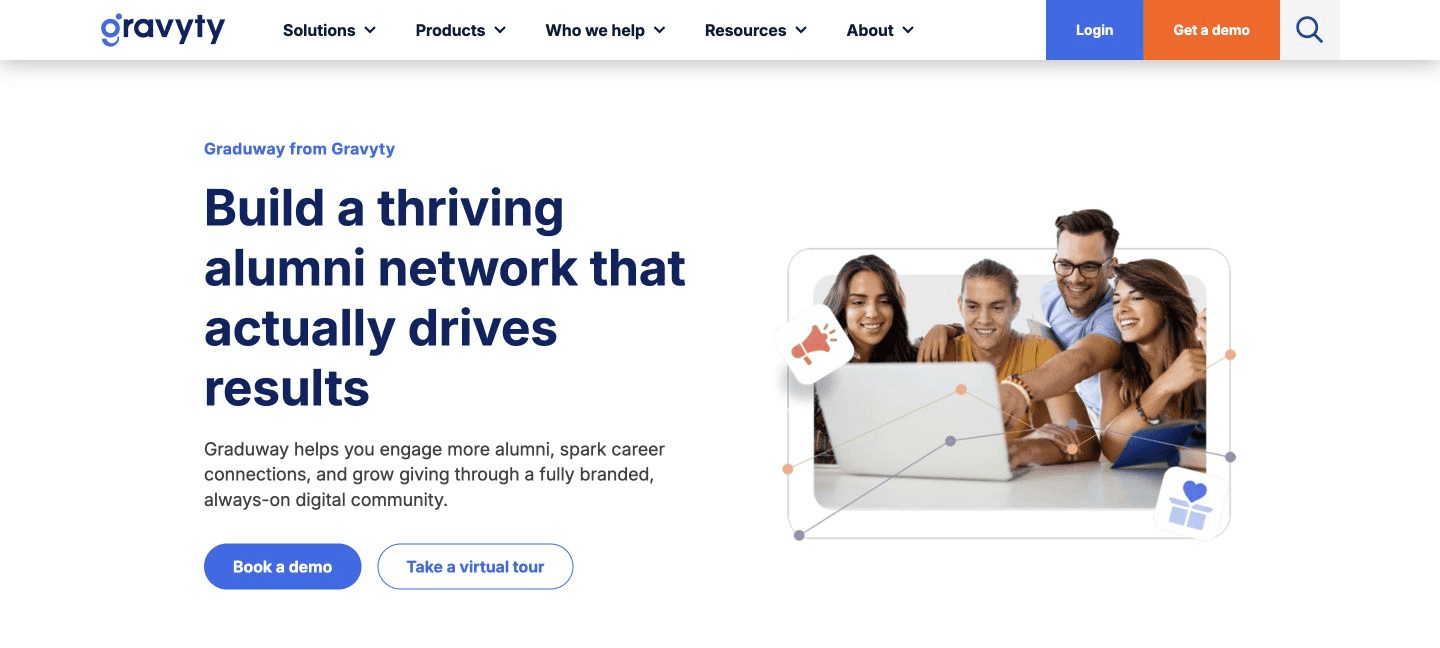
Overview
Graduway is Gravyty’s alumni community and engagement platform.
It is built around branded alumni networks and supports networking, mentoring, groups, events, career opportunities, communications, and advancement engagement.
What G2 users say
Graduway currently has a 4.6/5 G2 rating from 27 reviews.
G2’s current Alumni Management data shows Graduway scoring 8.9/10 for ease of use and 9.3/10 for support quality. Review summaries also highlight its range of engagement features and ability to help alumni connect with one another.
The review sample is much smaller than Hivebrite’s or Almabase’s, so I would put somewhat less weight on the aggregate score alone.
Pros
Strong emphasis on alumni-to-alumni connection
Networking and mentoring are central to the product
Gives institutions a branded digital destination for alumni
Positive G2 signals around ease of use and support
Fits institutions where ongoing digital community is a strategic priority
Cons and considerations
The biggest strategic question is whether your alumni will use another destination.
A community platform can provide excellent infrastructure, but the institution still needs a strategy to drive adoption, keep the community active, and re-engage alumni who never log in.
That is not a Graduway-specific criticism. It is a question I would ask about any portal or community product.
Best fit
Institutions that want alumni to network, find mentors, participate in groups, discover opportunities, and interact inside a branded digital community.
Less suited for
Teams whose main challenge is proactively running outbound campaigns to alumni who may never visit an online community.
Pricing
Graduway uses customized pricing. Confirm current pricing and implementation requirements directly with Gravyty.
Bottom line
Graduway makes the most sense when the community itself is central to your alumni strategy.
Its G2 scores for ease of use and support are encouraging. But if your engagement problem begins outside the portal, ask how your team will reach the people who never log in.
3. Hivebrite
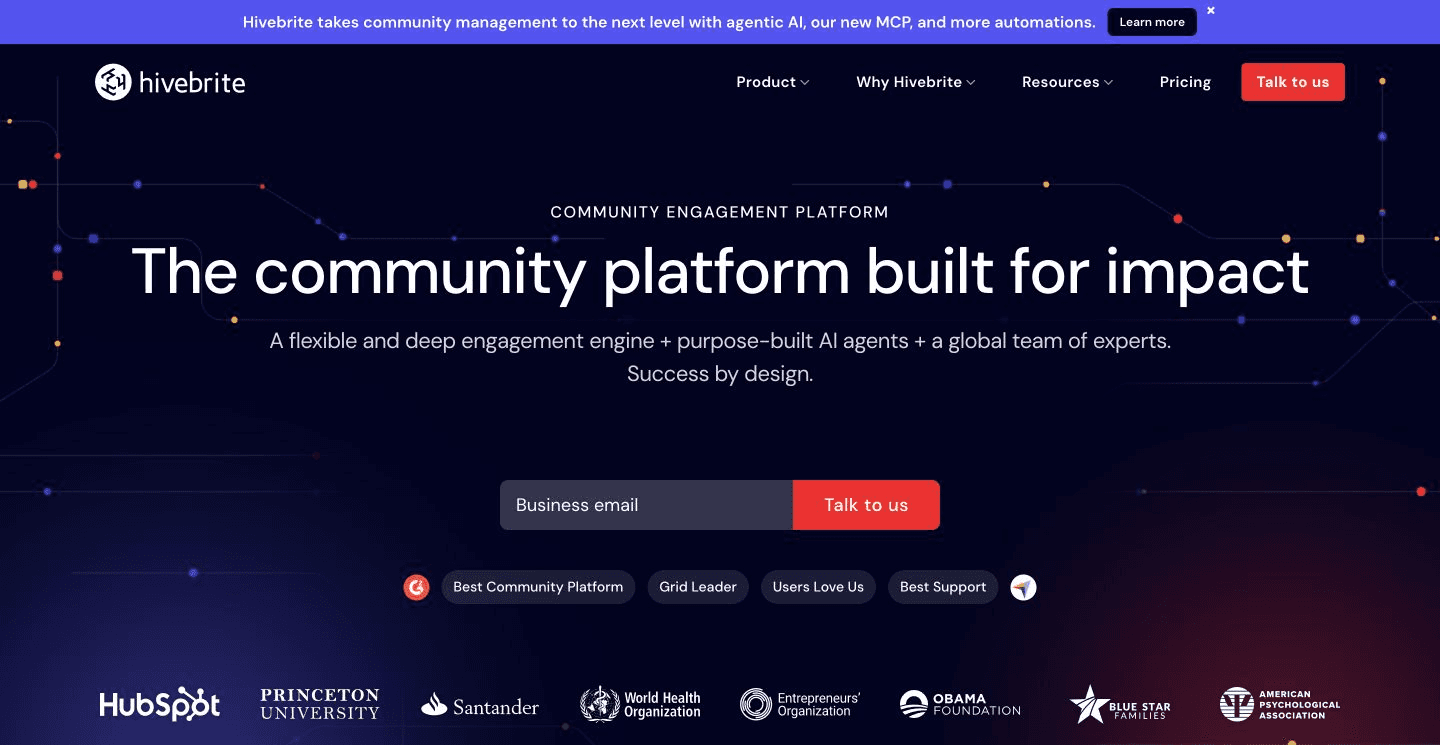
Overview
Hivebrite is a broader community-management platform used by universities, associations, nonprofits, and other membership-based organizations.
For higher education, it supports alumni directories, groups, chapters, events, mentoring, content, communications, and community management.
A helpful example is the University of Notre Dame, which has used Hivebrite for a large alumni community involving hundreds of clubs and groups. The point isn’t simply that Notre Dame uses Hivebrite. It shows the kind of problem the platform is designed to solve: operating a complex digital community with many subcommunities and volunteer leaders.
What G2 users say
Hivebrite has the largest product-level G2 review base in this comparison: 4.4/5 from 233 reviews.
That volume matters.
A larger review base does not guarantee a better product, but it gives you a broader pool of customer experiences to examine than a platform with 15 or 20 reviews.
Current G2 feedback often highlights the platform’s breadth, community-building capabilities, customer service, and flexibility. G2’s pricing analysis also notes that some reviewers view cost as a significant consideration, particularly for smaller organizations.
Pros
Largest product-level G2 review base among the five platforms compared here
Strong community-management capabilities
Useful for chapters, affinity groups, clubs, and other subcommunities
Supports events, content, directories, and member-to-member interaction
Flexible enough to support complex community structures
Cons and considerations
Current user feedback also gives buyers specific areas to investigate, including learning curve, pricing, and how much customization or additional functionality requires higher-tier packages.
Hivebrite is also a broader community platform rather than software designed exclusively around higher-ed advancement.
That can be a benefit or a limitation depending on what problem you are trying to solve.
Best fit
Institutions that need to operate a sophisticated online alumni community with chapters, groups, networking, events, and volunteer-led engagement.
Less suited for
Teams whose main need is outbound advancement campaigns and systematic follow-up rather than an online community.
Pricing
G2’s current pricing data lists Hivebrite’s Core plan starting at $895 per month billed annually, with Flex starting at $1,995 per month, and higher tiers requiring custom pricing.
Verify current pricing, included functionality, and implementation costs directly with Hivebrite.
Bottom line
Hivebrite becomes especially interesting when the complexity lies inside the community.
Its 233 G2 reviews also give Prospective buyers more third-party feedback to investigate than most alumni platforms in this comparison.
4. ToucanTech
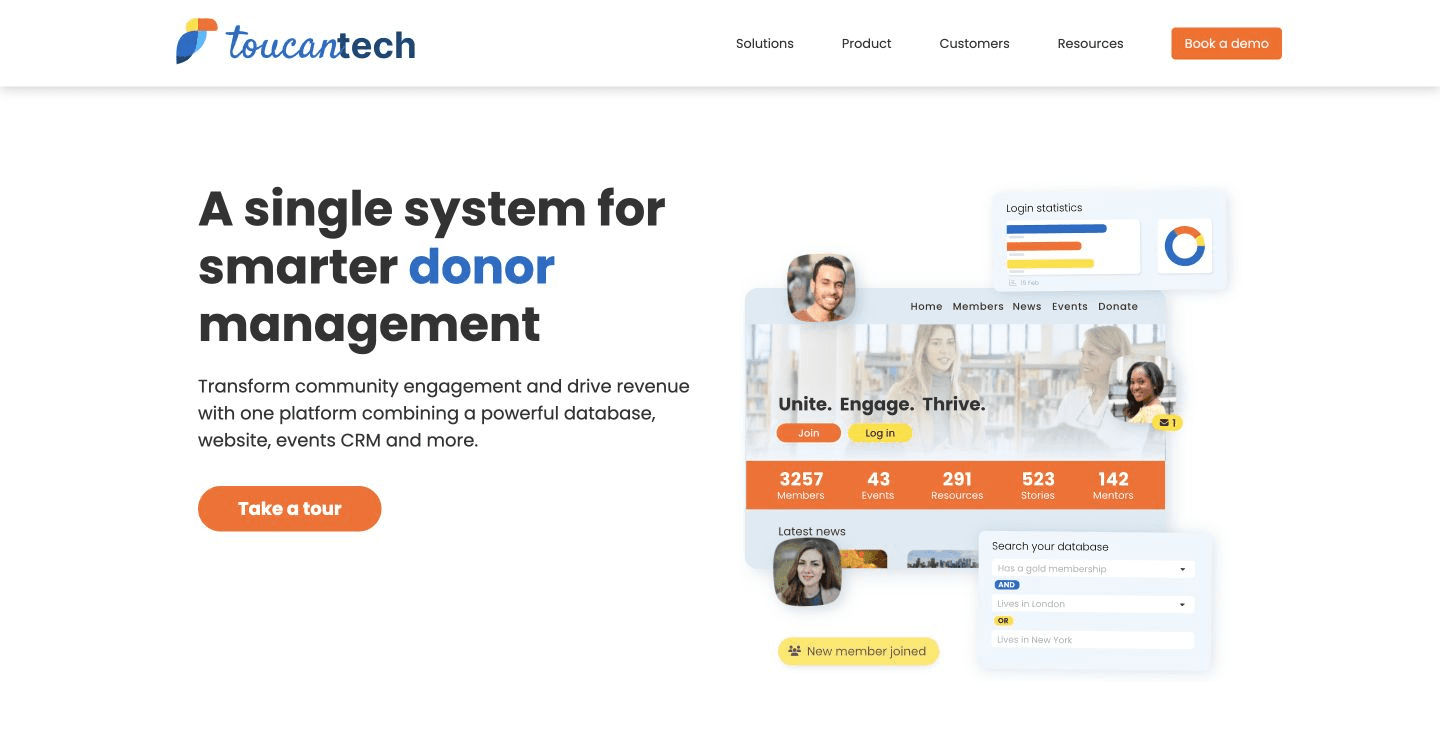
Overview
ToucanTech takes a more consolidated approach.
It combines database and CRM functionality with communications, events, websites or portals, community tools, and fundraising capabilities.
What G2 users say
ToucanTech currently has a 5.0/5 rating from 31 G2 reviews.
G2’s current Alumni Management data gives ToucanTech particularly strong marks for ease of use (9.4/10), quality of support (9.8/10), and ease of administration (9.5/10). Its review summary highlights customer support, an integrated platform, and straightforward administration.
Those are impressive signals.
The caveat is sample size. Thirty-one reviews are enough to be useful, but I wouldn’t conclude that a 5.0 makes ToucanTech “better” than a platform with hundreds of reviews.
Pros
Highest aggregate G2 rating among the five products reviewed here
Particularly strong G2 scores for support and ease of use
Broad all-in-one model
Combines database, communications, events, community, and fundraising functions
May reduce the number of systems a smaller team needs to manage
Cons and considerations
An all-in-one platform becomes less compelling when you already have strong systems performing most of those jobs.
If your university is committed to an enterprise CRM, giving platform, communications system, and website infrastructure, ask whether ToucanTech would replace meaningful complexity or simply add another layer.
Best fit
Small to midsize advancement or alumni teams looking to consolidate several systems.
Less suited for
Institutions already invested heavily in a mature technology stack and looking only for a specialized engagement layer.
Pricing
ToucanTech does not publish simple, standardized pricing. Ask for current pricing, implementation costs, and included functionality during the evaluation process.
Bottom line
ToucanTech is most compelling when consolidation itself is the goal.
Its G2 feedback is exceptionally positive. Just interpret the 5.0 rating alongside the 31-review sample rather than treating the number as a definitive ranking.
5. PeopleGrove
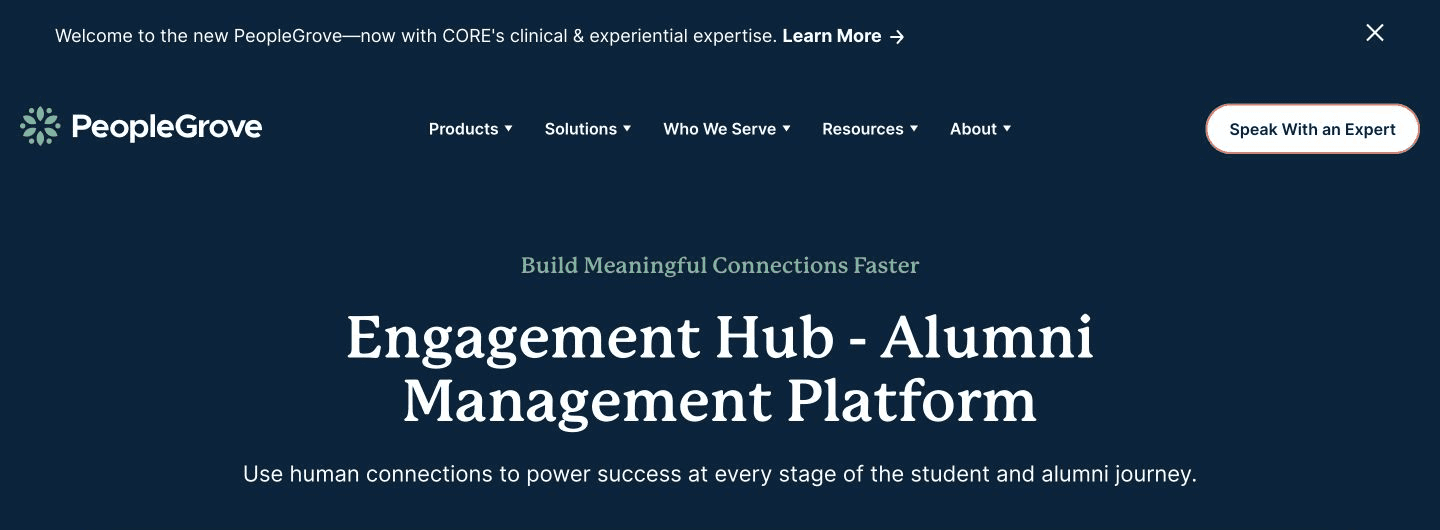
Overview
PeopleGrove approaches alumni engagement through the larger student-to-alumni relationship.
Its Engagement Hub emphasizes mentorship, career development, networking, alumni communities, and connections that can begin while someone is still a student and continue after graduation.
What G2 users say
PeopleGrove currently has a 4.5/5 rating from 15 G2 reviews.
Reviewers highlight networking, learning, career resources, events, and the ability to bring students and alumni together.
The most important caveat is review volume.
Fifteen reviews offer some useful qualitative feedback, but the sample is considerably smaller than those for Almabase or Hivebrite. I would therefore spend more time requesting current higher-education references during the sales process rather than relying heavily on the aggregate G2 score.
Pros
Strong mentoring and career-development focus
Connects student and alumni engagement rather than treating them as separate stages
Supports networking, career resources, communities, and events
Positive overall G2 rating
Useful for institutions thinking about engagement across the full student-to-alumni lifecycle
Cons and considerations
The smaller public review sample gives buyers less third-party evidence to evaluate.
Its career and mentoring focus also defines the platform’s lane. If your immediate problem is annual-giving outreach, event invitations, reactivation campaigns, or reaching thousands of alumni across several outbound channels, you may need a different type of platform alongside it.
Best fit
Institutions where mentorship, career development, student-alumni relationships, and professional networking are central to alumni strategy.
Less suited for
Teams primarily looking to increase capacity for proactive multichannel advancement campaigns.
Pricing
PeopleGrove directs institutions to its team for current pricing and packaging information.
Bottom line
PeopleGrove is differentiated by treating alumni engagement as part of a longer relationship that begins before graduation.
Its G2 feedback is positive, but the small review sample means I would pair that research with direct customer references.
What should you look for in an alumni engagement platform?
Once you understand the categories, the buying process becomes easier.
Do not ask vendors to spend an hour walking through their standard demos.
Give them the same problem.
For example:
We have 1,500 inactive alumni within 75 miles of Nashville. We want to invite them to an alumni event, identify people who want to reconnect, and make sure interested alumni reach the right staff member. Show us how your platform would handle that from beginning to end.
Then evaluate the workflow.
Question | What you are really testing |
|---|---|
How do we identify the audience? | Segmentation + data access |
How do we build the campaign or program? | Staff workload |
Which channels can we use? | Engagement capabilities |
What happens when someone responds? | Workflow logic |
How does an interested alum reach staff? | Human handoff |
What happens to incorrect information? | Data quality |
What can we measure afterward? | Outcomes |
What gets written back to our systems? | Integration |
How are preferences and opt-outs handled? | Governance |
This is more useful than comparing 75 checkboxes.
Buy the workflow, not the feature list.
For more practical ideas about what those workflows can look like, see our guides to alumni engagement strategies for advancement offices and annual giving in higher education.
Where EverRaise fits
EverRaise solves a different part of the alumni-engagement problem.
We are not building another alumni directory, mentoring network, advancement CRM, or online community.
EverRaise is an AI engagement assistant that helps advancement teams proactively reach and follow up with the people already in those systems.
For example, your CRM may tell you that 2,000 alumni have not meaningfully engaged in several years.
EverRaise helps your team take that audience and build a coordinated campaign across AI voice, SMS, and email. It can support contact validation before outreach, capture responses, coordinate follow-up, and help surface alumni who need a human next step.
That distinction is important.
A community platform gives alumni somewhere to connect.
A CRM helps your institution remember the relationship.
EverRaise helps your team proactively create the next interaction.
EverRaise does not yet have the volume of independent G2 reviews available for the established products above. That is worth stating plainly.
For a newer platform, buyers should ask for relevant customer examples, campaign results, a clear product demonstration, and the opportunity to understand exactly how the platform would fit into their existing advancement stack.
What we learned from one university campaign
In one university campaign we supported, EverRaise reached 868 contacts in less than five hours.
The campaign produced 163 live answers and 116 link clicks, while saving the university an estimated 20+ hours of staff time.
The lesson is not simply that technology can contact 868 people faster. The interesting part begins after the contact.
Who answered? Who clicked? Who expressed interest? Which records need attention? Who needs another touch? Which responses deserve a personal call from an advancement professional?
That is where the technology becomes useful.
Your people are not the inefficiency in the system. They are the point.
The platform should help your team spend less time manually executing structured outreach, so they have more time for the relationships and conversations that actually require a person.
Results will vary based on institution, audience, data quality, timing, message, channel, and campaign.
So, which alumni engagement platform should you choose?
There is no universal answer, and G2 ratings don’t change that.
Use them as another data point.
A high rating tells you customers have had positive experiences. Review volume tells you how much public evidence sits behind that rating. The reviews themselves can show what users repeatedly praise or struggle with.
But none of those things tell you whether the platform solves your problem.
If you need a digital alumni community, start with community platforms.
If mentoring and career connections are your priority, evaluate software built around those relationships.
If your team wants to consolidate its database, events, email, giving, and community tools, investigate broader alumni-management platforms.
And if you already have alumni data and systems in place but struggle to consistently activate the people inside them, evaluate technology designed around proactive engagement and follow-up.
You may need more than one platform. That is fine.
The goal should not be finding one piece of software that claims to do everything. It should be building an alumni engagement system where every tool has a clear job.
Identify the signal. Define the next step. Choose the channel. Decide who owns the response. Measure whether the relationship moved forward.
Then make the vendor show you exactly how its platform helps your team do that.
Because the goal is not more software.
It is stronger alumni relationships and more capacity for your advancement team to do the work that matters most.
Continue Reading
You might also like
View all posts

Pro Tips
Learn what donor engagement is and how to build a practical follow-up system that strengthens relationships, supports retention, and gives teams more capacity.

Pro Tips
Compare five telefundraising companies for nonprofits, including strengths, limitations, public review signals, and a modern AI alternative.
