Pro Tips
Compare five donor engagement software platforms for nonprofits, including pricing, strengths, limitations, and how to choose the right solution.

Jesse Wisnewski
CEO & Founder
Published
Read Time
14 min read

Your development team has 1,000 donors who gave last year but have not given this year. You know who they are, and your CRM has their records, giving history, and contact information.
But who will follow up?
Someone needs to decide which donors to contact, prepare the messages, launch the outreach, handle responses, and make sure interested supporters get the attention they need for a lean development team, that can be a lot of work.
That is the problem donor engagement software should help solve.
Some platforms combine donor management, fundraising, and communication in one system. Others emphasize automated donor journeys or more sophisticated fundraising operations. Another approach is to use an engagement assistant alongside the systems your organization already has.
The right choice depends on what is keeping your team from building stronger donor relationships.
In this post, I’m going to cover:
Five donor engagement software platforms worth comparing
Pricing, pros, cons, and the best fit for each
How we compared the platforms
What a useful vendor demonstration should include
Why data quality and follow-up matter
Where EverRaise fits
How to choose the right solution without adding unnecessary complexity
Let’s dig in.
Quick Comparison: 5 Donor Engagement Software Platforms
Platform | Best for | Primary approach | Starting price |
|---|---|---|---|
Bloomerang | Retention-focused nonprofits | CRM, donor insights, email, stewardship, and automated journeys | $125/month annually |
Virtuous | Growing fundraising teams | CRM, donor journeys, marketing automation, and responsive fundraising | Custom quote |
Blackbaud Raiser’s Edge NXT | Complex fundraising operations | Fundraising CRM, donor intelligence, workflows, and analytics | Custom quote |
Neon CRM | Small and midsize nonprofits | Donor management, fundraising, communications, and workflows | $99/month |
Givebutter | Fundraising-first organizations | Giving, events, CRM, email, and optional advanced automation | Free core platform |
Starting prices reflect publicly available information reviewed in October 2026. Additional products, processing fees, contact limits, implementation, and subscription terms can affect total costs.
A Note About Ratings and Reviews
I did not create an EverRaise score for these products. I also chose not to rank the platforms by a single public review rating because the available reviews do not always measure the same thing.
For example, some G2 listings cover individual CRM products, while others combine reviews across a company’s fundraising, CRM, and volunteer offerings. Review volume also varies considerably.
These reviews can help you understand usability, support, and customer experiences, but they are not a substitute for testing the workflows your team needs.
The more useful comparison is how well each product fits your organization.
How We Compared the Platforms
I used the same six questions for every platform:
What is the product’s primary job? Is it principally a fundraising CRM, giving platform, or engagement system?
How does it support outreach? What email, text, journey, and workflow capabilities are available?
What triggers follow-up? Can donor actions lead to appropriate messages, tasks, and next steps?
How does it handle donor information? Can teams segment supporters, maintain preferences, and work from reliable data?
What happens when a donor needs a person? Can staff see and act on important responses?
What does it cost? What is included, and what requires additional products or services?
The question underneath all six is simple: Will this platform help your team consistently do the relationship-building work it already knows it should do?
With that in mind, here are the five options.
1. Bloomerang: Best for Donor Retention and Stewardship

Bloomerang combines donor management with reporting, supporter insights, email marketing, and automated engagement tools. Its positioning emphasizes helping nonprofits understand and retain donors.
The CRM includes dynamic segmentation, donor activity tracking, email, automated supporter journeys, stewardship tasks, and fundraising insights. That makes it relevant for development teams that want to be more intentional about how they communicate with supporters between gifts.
Bloomerang also offers additional fundraising, event, text, and volunteer products, which can expand its capabilities.
Pros
Strong focus on donor retention and stewardship
Donor records, giving history, and engagement information together
Dynamic segmentation and reporting
Automated supporter journeys
Email marketing and communications
Major-gift and task management capabilities
Cons
Higher starting cost than some entry-level nonprofit CRMs
Additional products can increase total subscription costs
Teams should verify which communication capabilities are included in their package
Organizations that already have a suitable CRM may not need another system of record
Who Should Choose Bloomerang?
Best for: Nonprofits that want donor management, stewardship, reporting, and communications connected within one fundraising platform.
Not ideal for: Organizations satisfied with their current CRM that only need additional capacity for a narrow set of outreach campaigns.
Pricing: Bloomerang CRM starts at $125 per month, billed annually. See Bloomerang pricing.
Bottom line: Bloomerang is a good candidate when your priority is understanding donors and making stewardship a more consistent part of your fundraising operation.
2. Virtuous: Best for Responsive Fundraising and Automated Donor Journeys

Virtuous connects donor management, marketing automation, and fundraising workflows through its Responsive Fundraising approach.
Its CRM+ platform includes donor and pipeline management, segmentation, communications, reporting, event management, and workflow automation. Virtuous helps organizations use donor information to create more relevant communication and fundraising experiences.
For example, teams can build donor journeys and use automation to support ongoing stewardship rather than relying entirely on one-off campaigns.
Pros
Strong focus on responsive fundraising
CRM and donor pipeline management
Marketing and communications tools
Workflow and journey automation
Segmentation and donor insights
Reporting and analytics
Unlimited CRM users
Cons
Public subscription pricing is not listed
Implementation may require more planning than a lightweight tool
Advanced capabilities and additional products can affect total cost
Smaller nonprofits may not need the full fundraising ecosystem
Who Should Choose Virtuous?
Best for: Growing nonprofit development teams that want to connect donor data, communication, and automation within a broader fundraising strategy.
Not ideal for: Organizations that need only basic donor tracking or a small, standalone outreach tool.
Pricing: Custom quote. See Virtuous pricing and packaging.
Bottom line: Virtuous deserves consideration when your organization wants donor journeys and fundraising automation to become central parts of its operating model.
3. Blackbaud Raiser’s Edge NXT: Best for Complex Fundraising Operations
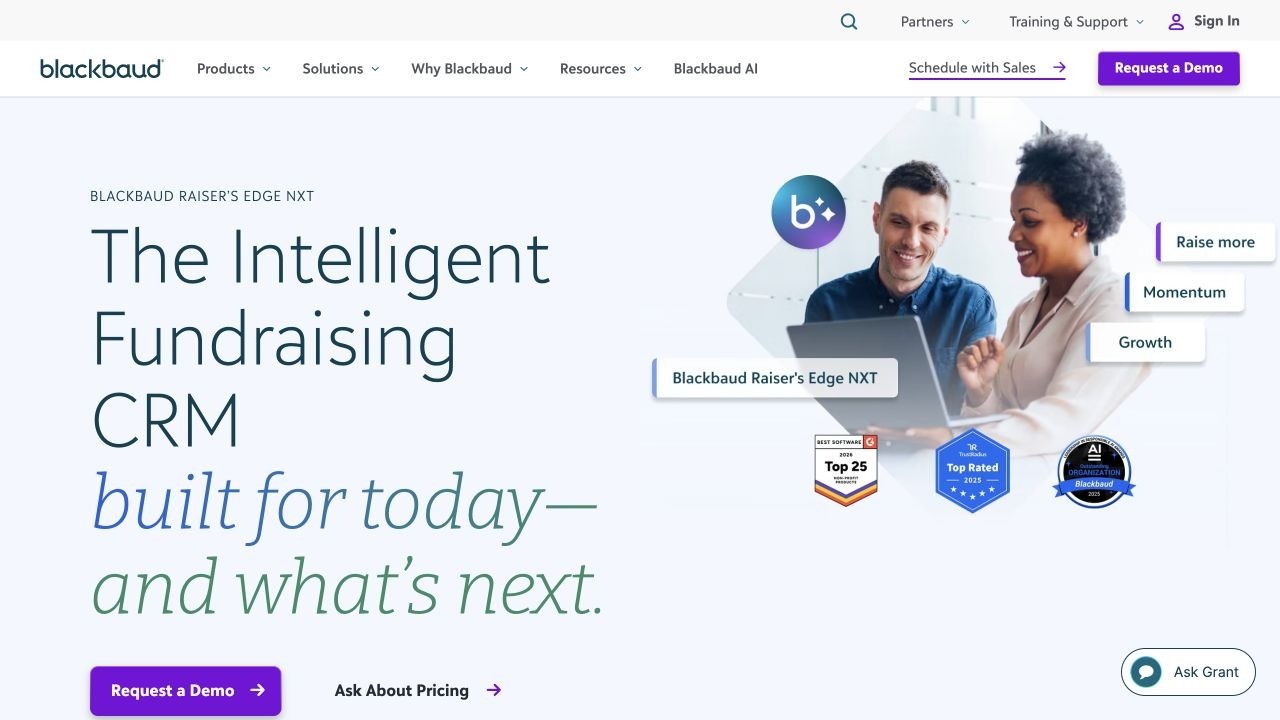
Blackbaud Raiser’s Edge NXT is an established fundraising CRM designed for organizations managing complex constituent relationships and fundraising programs.
Its current offering includes donor records, gift management, fundraising analytics, workflows, and AI-assisted fundraising tools. Blackbaud also describes capabilities for preparing donor summaries, identifying opportunities, supporting stewardship, and recommending next steps.
For a national nonprofit, university, hospital foundation, or large ministry, those capabilities may be important. These organizations often manage multiple fundraising teams, complex giving histories, major-donor portfolios, and substantial reporting needs.
Pros
Comprehensive fundraising CRM
Detailed donor and gift management
Major-gift and portfolio capabilities
Reporting and fundraising intelligence
AI-assisted donor insights
Communication and workflow tools
Broad nonprofit software ecosystem
Cons
Public pricing is not listed
Implementation and administration can require more organizational resources
Advanced capabilities need careful review by package
Smaller development teams may not need its level of complexity
Who Should Choose Raiser’s Edge NXT?
Best for: Midsize and large nonprofits, universities, foundations, and organizations with sophisticated fundraising operations.
Not ideal for: Small teams primarily trying to launch simple engagement campaigns without changing their CRM.
Pricing: Custom quote. See Blackbaud’s pricing information.
Bottom line: Raiser’s Edge NXT makes sense when your organization needs a substantial fundraising system of record with intelligence and workflows around it.
4. Neon CRM: Best for Small and Midsize Nonprofits Managing Multiple Relationships

Neon CRM combines donor management, fundraising, communications, events, and other nonprofit operations.
Its automation tools can respond to events such as new gifts, changes in giving activity, membership renewals, and other database conditions. Those triggers can support thank-you messages, welcome journeys, reminders, tasks, and donor follow-up.
That makes Neon particularly relevant for organizations managing donors alongside members, volunteers, and event participants.
Pros
Donor management and fundraising together
Email marketing and text communication
Automated workflows
Welcome and stewardship journeys
Reporting and dashboards
Unlimited contact records
Optional event, membership, and volunteer modules
Cons
Additional modules affect total cost
Revenue-based pricing changes as the organization grows
Broader functionality can require setup and training
Organizations should verify which automation features are included in their selected package
Who Should Choose Neon CRM?
Best for: Small and midsize nonprofits that want donor engagement workflows connected to fundraising and broader constituent management.
Not ideal for: Teams seeking only a specialized engagement layer around an existing CRM.
Pricing: Neon CRM starts at $99 per month. See Neon CRM pricing.
Bottom line: Neon is worth evaluating when your organization needs a CRM that connects donor management with several types of nonprofit engagement.
5. Givebutter: Best for Fundraising-First Organizations

Givebutter brings donor management, fundraising campaigns, events, communications, and reporting into one platform.
The core system is free and includes donor records, fundraising tools, segmentation, and email capabilities. Givebutter Plus adds more advanced engagement features, including expanded workflows, task management, texting, and reporting.
This makes Givebutter appealing for organizations where donor engagement is closely connected to online fundraising and events.
Pros
Free core fundraising and CRM platform
Unlimited contacts and users
Donation forms, campaigns, and events
Segmentation and email communication
Automated transaction-related messages
Optional advanced workflows through Givebutter Plus
Cons
Advanced engagement capabilities require a paid subscription
Givebutter Plus pricing increases with contact count
The optional-tip model may affect the donor checkout experience
Organizations should evaluate whether its workflows cover engagement beyond giving and events
Who Should Choose Givebutter?
Best for: Nonprofits that want donor management and fundraising campaigns in one accessible platform.
Not ideal for: Organizations with complex engagement requirements that go well beyond fundraising transactions and standard donor communications.
Pricing: Free core platform. Givebutter Plus starts at $29 per month with annual billing for smaller contact lists. Fee terms depend on campaign settings. See Givebutter pricing.
Bottom line: Givebutter is a strong candidate when online giving, campaigns, and event fundraising are central to how your organization engages supporters.
Which Donor Engagement Software Should You Choose?
I would narrow the options based on your primary problem.
Choose Bloomerang when donor stewardship, retention, and CRM-connected communication are your priorities. Choose Virtuous when your team wants sophisticated donor journeys and responsive fundraising automation.
Raiser’s Edge NXT is worth considering when your organization needs a complex fundraising CRM with donor intelligence and broader workflows. Neon CRM makes sense when you manage donors alongside members, volunteers, events, and other nonprofit activities.
And Givebutter is a strong option when giving, campaigns, events, and donor communications are closely connected.
But there is another situation worth considering.
What if your organization already has the CRM it needs? What if you can identify the donors who should receive attention, but your team lacks the time to reach them consistently?
That is not necessarily a donor-management problem. It may be an engagement-capacity problem.
The Best Donor Engagement Software Should Pass This Test
Here is the vendor demonstration I would run.
Give every company the same situation:
We have 1,000 donors who gave last year but have not given this year. We want to reconnect with them, listen to their responses, and identify who needs personal follow-up.
Then ask the vendor to demonstrate the entire process.
Step | What the vendor should show |
|---|---|
Identify | How do we create the audience using giving history and donor information? |
Prepare | How do we check contact quality and honor preferences and suppressions? |
Engage | What channels can we use, and how do we launch approved outreach? |
Respond | What happens when someone replies, requests information, or asks not to be contacted? |
Handoff | How does a donor who needs a person reach the appropriate staff member? |
Record | How do outcomes return to the donor’s record or system of truth? |
Measure | Can we see conversations, responses, completed next steps, reactivation, and cost? |
Ask the vendor to demonstrate each step live. Then classify the result as included in the product, requiring an additional module or integration, requiring manual staff work, or not currently supported.
That gives you a much more useful comparison than simply checking boxes for email, SMS, automation, and AI.
A platform with ten channels but no reliable follow-up process may be less useful than a simpler tool that helps your team complete the right next step.
Why This Matters for Donor Retention
The Fundraising Effectiveness Project’s 2025 results highlight why nonprofit leaders should pay attention to engagement.
Total charitable dollars increased an estimated 5.0% in 2025, but the number of donors declined 3.6%, and overall donor retention was 43.3%. That means an organization can raise more money while still losing supporters.
These results do not prove that more outreach would have prevented those losses. Donors stop giving for many reasons, but the findings make one thing clear: maintaining a healthy supporter base deserves attention.
Retention is something you measure after many smaller relationship experiences have already happened.
The thank-you was sent or missed. A donor’s question got an answer or didn’t. An event attendee heard from someone afterward or never did. A recurring payment failed, and someone responded, or nobody noticed.
Those individual moments are where donor engagement becomes practical.
For more on the relationship between those experiences and retention, see our donor retention strategies guide.
A Real-World Example: Kent State Changed the Operating Model
Kent State University offers a useful example of why you should evaluate engagement technology around the relationship rather than the channel.
According to a CASE article about its Alumni Engagement Center, the university’s traditional phonathon had struggled to generate positive ROI. Over five years, new commitment dollars from the phone center declined 56%.
Rather than simply buying another calling tool, Kent State redesigned the program.
In 2023, it opened a multichannel Alumni Engagement Center with a broader emphasis on connection and stewardship alongside fundraising.
The lesson is not that every nonprofit needs to copy Kent State. It is that changing the operating model can matter more than adding another software feature.
The purpose of calling changed, and the relationships became more central to the program.
That is the question I would encourage nonprofits to ask about their own engagement tools: Does the software help us complete more activities, or does it help us create better donor experiences?
Where EverRaise Fits
This is the problem we are working to solve at EverRaise.
EverRaise is not a fundraising CRM or donor database. It is an AI engagement assistant for relationship-driven organizations.
Many nonprofits already have the information they need to identify supporters worth engaging. What they lack is the capacity to act on it consistently.
Your CRM may tell you who gave for the first time, who attended an event, who stopped giving, or who requested information.
EverRaise helps your team turn approved campaign audiences into coordinated outreach through AI voice, SMS, email, surveys, and follow-up workflows. It also supports data validation so teams can identify contact records that may need attention before launching outreach.
The goal is not to make your staff responsible for fewer relationships. It is to give them more capacity to maintain those relationships.
What We Learned From One University Campaign
In a university engagement campaign, EverRaise reached 868 contacts in less than five hours. The campaign generated:
163 live answers
116 link clicks
More than 20 estimated staff hours saved
We reported those results in our September EverRaise product update.
Those numbers come from one campaign. They don’t demonstrate an increase in donor retention, and they shouldn’t be treated as typical results.
The more interesting lesson is what the campaign made possible. The organization could identify who answered, who clicked, and where additional engagement might be useful.
Staff could spend less time manually executing structured outreach and more time attending to responses that needed personal judgment.
That is how I think AI should support donor relationships. Your people are not the inefficiency in the system. They are the point.
No matter which tool you use, your team should remain responsible for audience selection, permissions, messaging, disclosures, opt-outs, privacy, and human follow-up.
What Should Donor Engagement Software Measure?
I would separate activity from meaningful outcomes.
Activity tells you how much communication happened. Engagement helps you understand what it produced.
Depending on your campaign, useful measures include:
Valid and reachable contacts
Live conversations
Responses and replies
Survey participation
Event registrations
Requested staff conversations
Contact preference updates
Completed follow-up
Lapsed-donor reactivation
First-to-second gift conversion
Donor retention over time
Not every campaign needs every metric. An event reminder should be evaluated differently from a donor reactivation campaign.
The important question is whether the platform measures progress toward the actual goal.
Also, keep contact quality and permission separate. A valid phone number or deliverable email address does not automatically mean your organization has permission to use it for a particular campaign.
For a deeper explanation of reachability, data quality, and communication preferences, see our guide to nonprofit data hygiene.
Frequently Asked Questions About Donor Engagement Software
What is donor engagement software?
Donor engagement software helps nonprofits build and maintain supporter relationships through communication, segmentation, follow-up, automated workflows, interaction tracking, and reporting. Some platforms include these capabilities within a fundraising CRM, while others specialize in outreach and engagement.
What is the difference between donor engagement software and a donor CRM?
A donor CRM organizes supporter information, giving history, relationships, and fundraising activity. Donor engagement software helps teams use that information to communicate, collect responses, and coordinate next steps. Many nonprofit CRMs include engagement tools, so the categories often overlap.
What is the best donor engagement software for nonprofits?
The best choice depends on your organization’s existing systems and goals. Bloomerang emphasizes donor stewardship, Virtuous focuses on responsive fundraising and automation, Raiser’s Edge NXT supports complex fundraising operations, Neon CRM combines nonprofit management and workflows, and Givebutter connects engagement with online fundraising and events.
Can donor engagement software improve retention?
Donor engagement software can support retention by helping teams identify important donor moments, communicate consistently, respond to supporters, and complete follow-up. It does not guarantee that donors will continue giving.
Can nonprofits use AI for donor engagement?
Yes. AI can help prepare campaigns, support selected structured conversations, coordinate follow-up, analyze results, and identify when staff attention is needed. Sensitive, complex, and high-stakes donor relationships still require human judgment.
Any automated outreach should follow applicable consent, disclosure, privacy, and opt-out requirements.
The Bottom Line
The wrong way to evaluate donor engagement software is to ask which platform has the longest feature list.
Start with the donor relationship. Where is follow-up breaking down? What information does your team already have? Which conversations require a person, and which steps could technology help your team complete more consistently?
Then choose the platform that solves the actual problem.
You may need a better CRM or more sophisticated fundraising automation. Or you may already have the right donor database and need more capacity to engage the people inside it.
The goal is not more software. It is stronger relationships.
Engagement drives retention. Retention drives revenue.
Continue Reading
You might also like
View all posts

Pro Tips
Learn donor communication best practices for new, active, and lapsing donors, plus a practical system for consistent follow-up and stronger relationships.

Pro Tips
Learn which fundraising data matters most, including donor lifetime value, retention, acquisition cost, ROI, and how to turn insights into action.
