Pro Tips
Compare five telefundraising companies for nonprofits, including strengths, limitations, public review signals, and a modern AI alternative.

Jesse Wisnewski
CEO & Founder
Published
Read Time
13 min read

If your development team wants to make more donor calls, one option is to hire a telefundraising company.
That can solve a real problem.
Instead of recruiting callers, training them, managing shifts, building scripts, handling call-center technology, and tracking results yourself, you pay another organization to do much of that work for you.
But telefundraising companies are not interchangeable.
Some specialize almost entirely in nonprofit phone fundraising. Some focus on higher education. Some have deep experience with arts and cultural organizations. Others operate as larger contact-center businesses with fundraising as one part of a broader service.
And there is now another option: use AI voice and connected follow-up to replace the outsourced calling layer for campaigns that do not require a human fundraiser on every call.
So, which model makes sense for your team?
In this post, I’m going to cover:
5 telefundraising companies worth comparing
The same criteria we used for every provider
Pros and cons for each
Where EverRaise can replace a traditional telefundraising company
When you should still use human callers
Let’s dig in.
Quick Comparison: 5 Telefundraising Companies
Company | Best for | Core model | Multichannel | Pricing | Glassdoor |
|---|---|---|---|---|---|
Traditional nonprofit telefundraising | Live-agent inbound/outbound | Phone + mail | Custom quote | ||
Higher ed advancement | Managed engagement + software | Call + text + video + email | Custom quote | ||
Arts, culture, membership | Live-agent telefundraising | Primarily phone | Custom quote | ||
Large nonprofits / BPO | Full-service BPO | Phone + SMS + email + chat/social | Custom quote | ||
Progressive / advocacy | Live-agent + data / fulfillment | Phone + mail | Custom quote |
A Note About the Ratings
There is no G2 or Capterra equivalent that consistently reviews all of these telefundraising firms as vendors.
So I did not create a proprietary score or pretend we had run mystery-shopper campaigns with each provider.
For a single consistent public review signal, I used Glassdoor’s current company rating and review count across all five providers.
That is not a customer-satisfaction score.
It is an employee rating.
Why include it at all?
Because this is a people-heavy service. Caller training, supervision, turnover, working conditions, and management can affect the people who eventually speak with your donors. It is one useful signal, but it should never be the only one you use.
I also left CTC TeleFund out of the primary comparison because I could not verify a current Glassdoor company rating for it to the same standard. Rather than mix rating sources, I kept the table to providers with comparable public review data.
How We Compared the Companies
I reviewed each company using the same six questions:
1. How focused is the company on nonprofit fundraising?
2. What types of campaigns does it publicly support?
3. Does it provide only human calling, or does it connect phone outreach with other channels?
4. What technology, data, reporting, or analytics does it describe?
5. Is pricing publicly available?
6. What does the same public workforce-review source show?
I also looked for evidence that nonprofits actually use these firms.
Public Form 990 vendor data is helpful here. It does not tell you whether a campaign worked, but it can confirm that real nonprofit organizations have paid a company for fundraising or related services.
With that context in mind, here are the five providers.
1. MDS Communications: Best for Traditional Nonprofit Telephone Fundraising
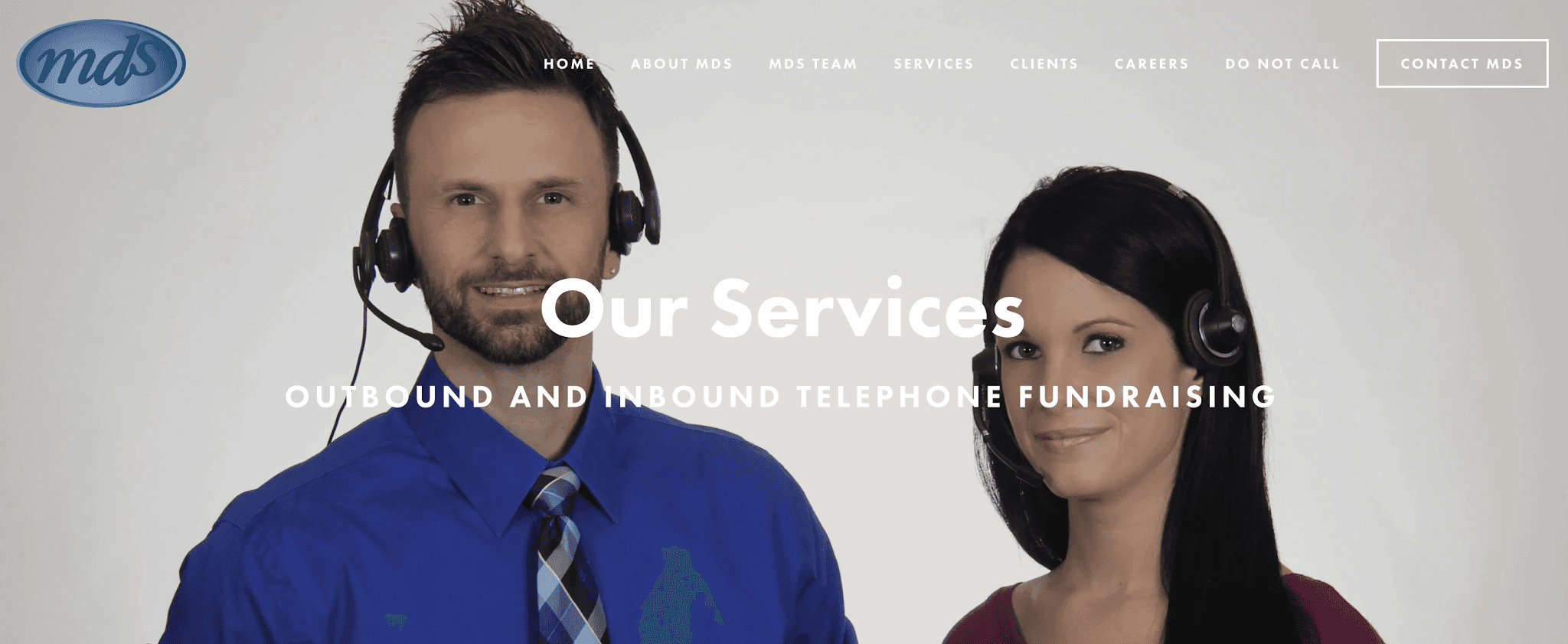
MDS Communications — Our Services
MDS Communications is the purest traditional telefundraising company on this list.
The company says telephone fundraising for nonprofits is its sole focus. Its services include donor renewal, new-donor follow-up, monthly giving, thank-you and welcome calls, lapsed-donor reactivation, acquisition, inbound fundraising, analytics, and mail fulfillment.
That narrow focus is a strength if you know exactly what you want: trained people making fundraising calls on your behalf.
MDS also says it has operated since 1992, employs hundreds of people, and makes millions of fundraising calls each year.
There is independent evidence of real nonprofit adoption, too. Public Form 990 vendor data show that organizations, including Heifer International, Operation Smile, Feeding America, Save the Children, and Special Olympics, report payments to MDS-related entities for fundraising or telemarketing work.
Pros
Nonprofit fundraising is the company’s primary focus
Supports both inbound and outbound fundraising
Covers renewal, reactivation, acquisition, monthly giving, thank-you calls, and surveys
Publicly emphasizes caller training, quality monitoring, analytics, and PCI-compliant payment handling
MDS says clients can cancel with one day’s notice
Strong evidence of use by established nonprofits
Cons
The operating model is still primarily a staffed telephone fundraising model
Public pricing is not listed
The website describes coordinated multichannel messaging, but its core delivery remains phone plus traditional fulfillment rather than a unified voice/SMS/email workflow
Its current Glassdoor workforce rating is 2.7/5 from 89 reviews, which is worth asking about when evaluating caller recruitment, management, and retention
Who Should Choose MDS?
Best for: Established nonprofits that want professional human callers handling traditional fundraising conversations.
Not ideal for: Lean teams that mainly need scalable, structured follow-up and do not want the cost or operational dependency of an outsourced caller workforce.
Pricing: Contact MDS for a quote.
Bottom line: If you want a traditional fundraising call center with deep nonprofit expertise, MDS deserves a place on the shortlist.
2. Ruffalo Noel Levitz: Best for Higher Education
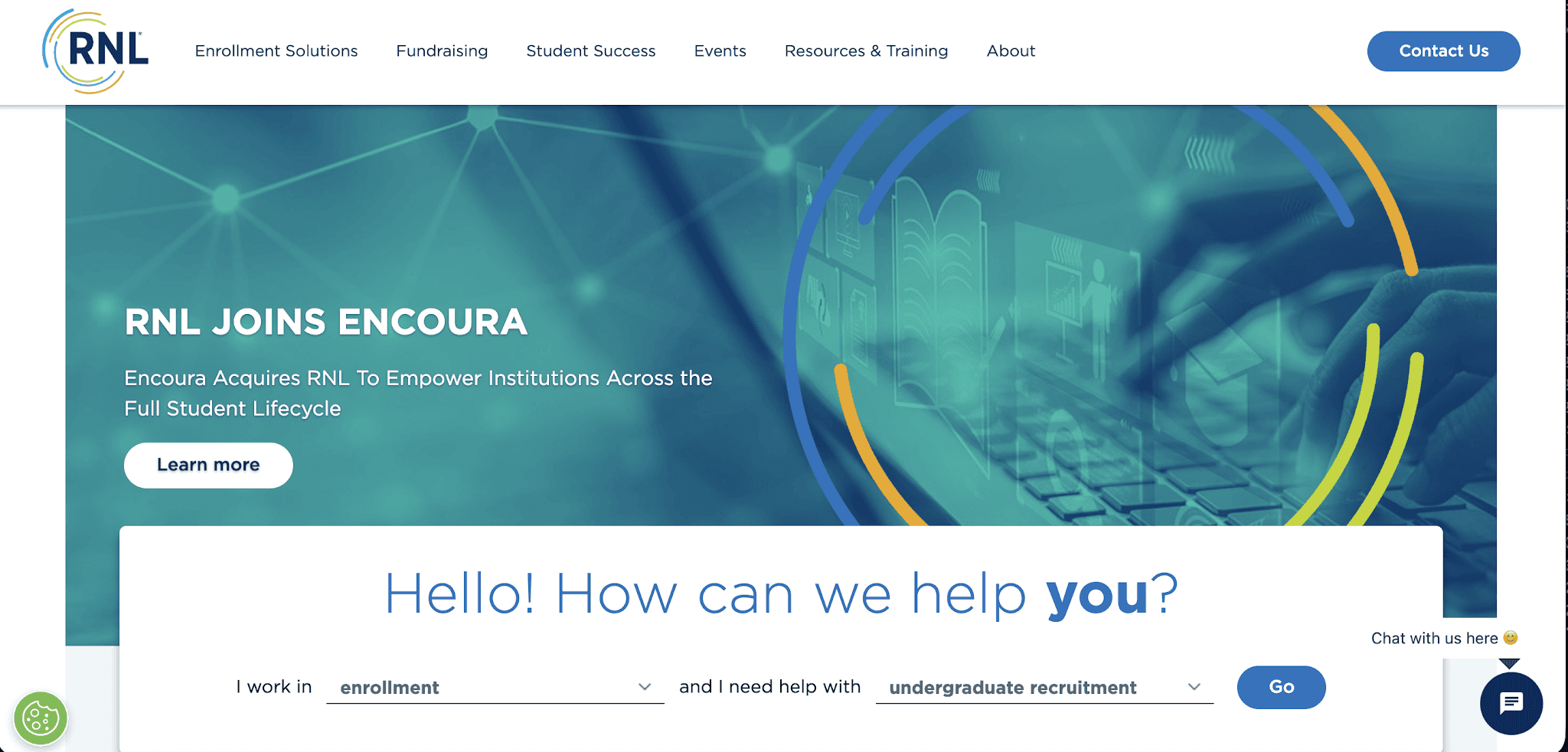
Ruffalo Noel Levitz, or RNL, is the clearest fit for colleges and universities.
Its current model has moved well beyond the traditional campus phonathon.
RNL offers on-campus programs, selective phonathon, off-site managed calling, CAMPUSCALL software, data services, analytics, texting, video, and what it calls the Digital Engagement Center.
RNL says nearly 500 institutions use its phonathon solutions and that its callers hold millions of donor and alumni conversations each year.
Public Form 990 data also show that universities and foundations report payments to RNL for fundraising, call-center management, donor engagement, and related services. Examples include Rutgers, the University of Florida Foundation, WVU Foundation, LSU Foundation, and others.
Pros
Deep specialization in higher education advancement
Offers both managed calling and do-it-yourself software
More mature multichannel offering than most traditional telefundraising firms
Combines calling with texting, video, email, data, and analytics
Large higher-education footprint
Highest Glassdoor workforce rating in this comparison at 3.5/5 from 1,327 reviews
Cons
The product and service ecosystem is built heavily around higher education
Public pricing is not listed
The mix of consulting, software, managed services, data, and engagement products can be more complex than a small nonprofit needs
Organizations outside of advancement may find a more general nonprofit platform easier to fit into
Who Should Choose RNL?
Best for: Universities running annual giving, alumni engagement, phonathon, or digital engagement-center programs.
Not ideal for: Small nonprofits that simply need to run a few repeatable donor-outreach campaigns without building or outsourcing a full engagement center.
Pricing: Contact RNL.
Bottom line: If you work in higher education and want a managed or software-supported successor to the traditional phonathon, RNL is the most specialized option in this group.
3. SD&A Teleservices: Best for Arts, Culture, Membership, and Public Media
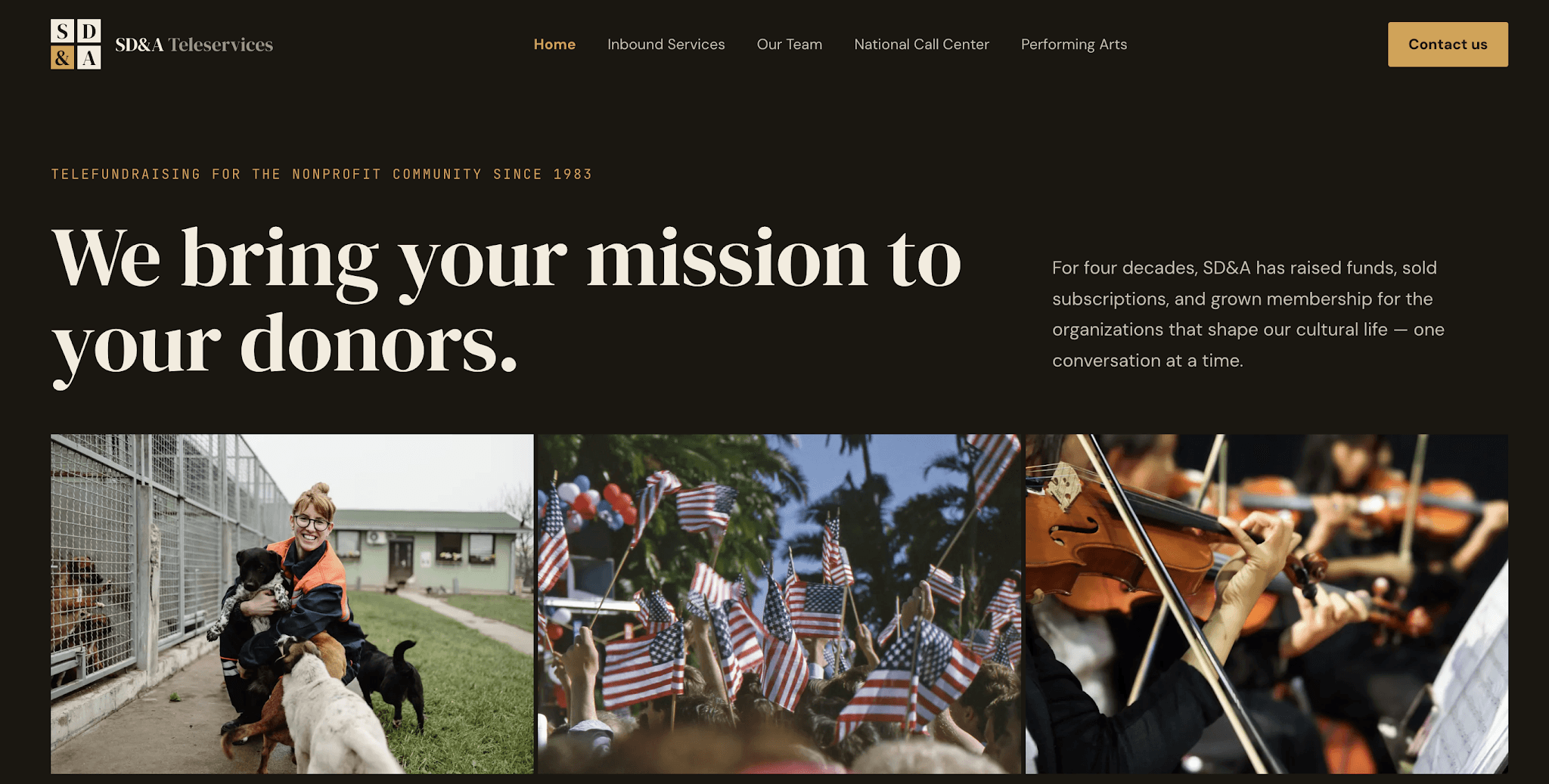
SD&A has been in telefundraising since 1983.
Its strongest public positioning is around organizations where memberships, subscriptions, and donor relationships often overlap: performing arts, museums, public broadcasting, zoos, aquariums, botanical gardens, and other cultural nonprofits.
SD&A says it has raised more than $1 billion for nonprofits and made more than 30 million donor connections over its history.
Its proprietary FLEX platform supports campaigns run through telecenters and remote agents, with reporting and PCI-compliant security.
Public Form 990 records also show a broad real-world nonprofit footprint. Organizations reporting payments to SD&A include the ASPCA, Los Angeles Philharmonic, Médecins Sans Frontières USA, New York City Ballet, Sierra Club, UNICEF-related entities, museums, public media, and other nonprofits.
Pros
More than four decades in nonprofit telefundraising
Particularly strong fit for arts, culture, membership, subscription, and public media organizations
Experience with both fundraising and ticket/subscription programs
Proprietary platform and remote-agent model
Public 990 data shows use across a wide variety of recognizable nonprofits
Glassdoor workforce rating of 3.2/5 from 67 reviews
Cons
The company’s deepest specialization may be less relevant for nonprofits without a membership, arts, culture, or subscription model
Public pricing is not listed
Public product information still centers primarily on human calling rather than an integrated voice, SMS, and email engagement workflow
Smaller public review footprint than RNL or InfoCision
Who Should Choose SD&A?
Best for: Arts organizations, museums, public broadcasters, cultural institutions, and nonprofits where fundraising overlaps with memberships or subscriptions.
Not ideal for: Teams looking primarily for software they can own and operate themselves across voice, SMS, and email.
Pricing: Contact SD&A.
Bottom line: SD&A is one of the strongest specialized options if your organization sits in the cultural, membership, or public media world.
4. InfoCision: Best for Large-Scale Omnichannel BPO
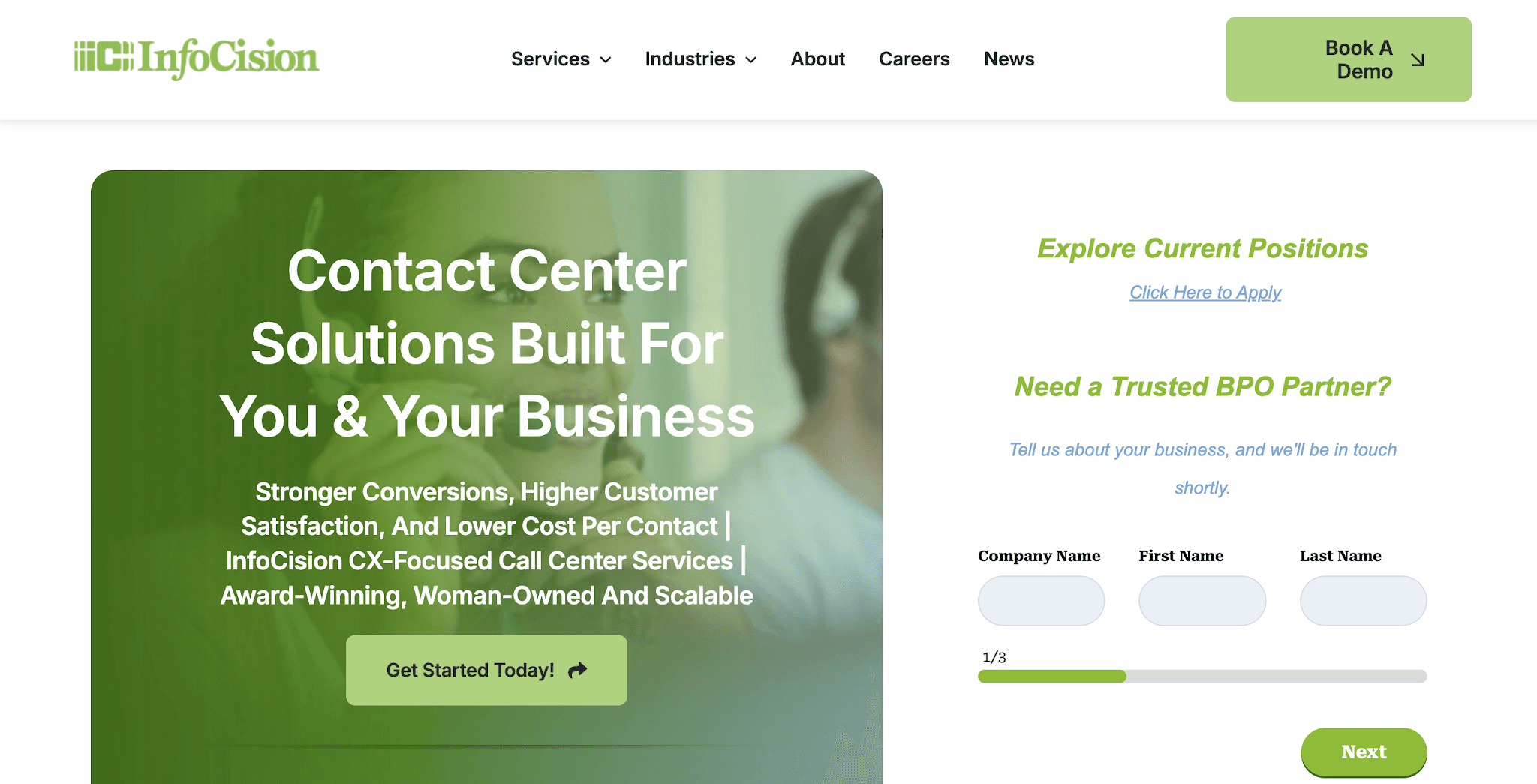
InfoCision — Outbound Nonprofit Fundraising
InfoCision is different from the first three companies.
It is not a nonprofit-only telefundraising firm. It is a much broader contact center and business process outsourcing company, with nonprofit fundraising as one of its service lines.
That can be an advantage if your organization needs more than outbound fundraising.
InfoCision offers inbound donor support, outbound reactivation and upgrades, payment processing, multilingual operations, analytics, CRM integration, SMS, email, chat, social communication, and AI-assisted tools.
The company says it has more than 40 years of nonprofit fundraising experience and operates across multiple U.S. states and international locations.
Public Form 990 data shows nonprofit organizations reporting payments to InfoCision entities for fundraising and call-center work, including Special Olympics, American Institute for Cancer Research, Save the Children, UNICEF-related entities, and other national organizations.
Visual to use: Screenshot of the InfoCision nonprofit fundraising page showing outbound fundraising, donor upgrades, lapsed reactivation, and multichannel outreach.
Pros
Broadest contact-center capabilities in this comparison
Supports both inbound and outbound donor programs
Publicly describes phone, SMS, email, chat, social, analytics, CRM integration, and AI-assisted workflows
Can support large, complex programs beyond a single fundraising campaign
Long operating history
Global and multilingual capabilities
Cons
Nonprofit fundraising is only one part of a much larger BPO business
May be more operationally complex than a small or mid-sized nonprofit needs
Public pricing is not listed
Its current Glassdoor workforce rating is 1.9/5 from 817 reviews, the lowest same-source workforce rating in this comparison
Teams should ask specifically how nonprofit callers are recruited, trained, managed, and separated from other contact-center programs
Who Should Choose InfoCision?
Best for: Larger nonprofits that need a broad outsourced contact-center partner across donor service, inbound response, outbound fundraising, and multiple communication channels.
Not ideal for: Lean development teams seeking a simple, fundraising-specific tool or campaign platform.
Pricing: Contact InfoCision.
Bottom line: InfoCision is the broadest BPO option here. That breadth can be valuable, but it also means buyers should carefully evaluate whether they need a full contact-center partner or simply more fundraising capacity.
5. Telefund: Best for Progressive and Advocacy Organizations
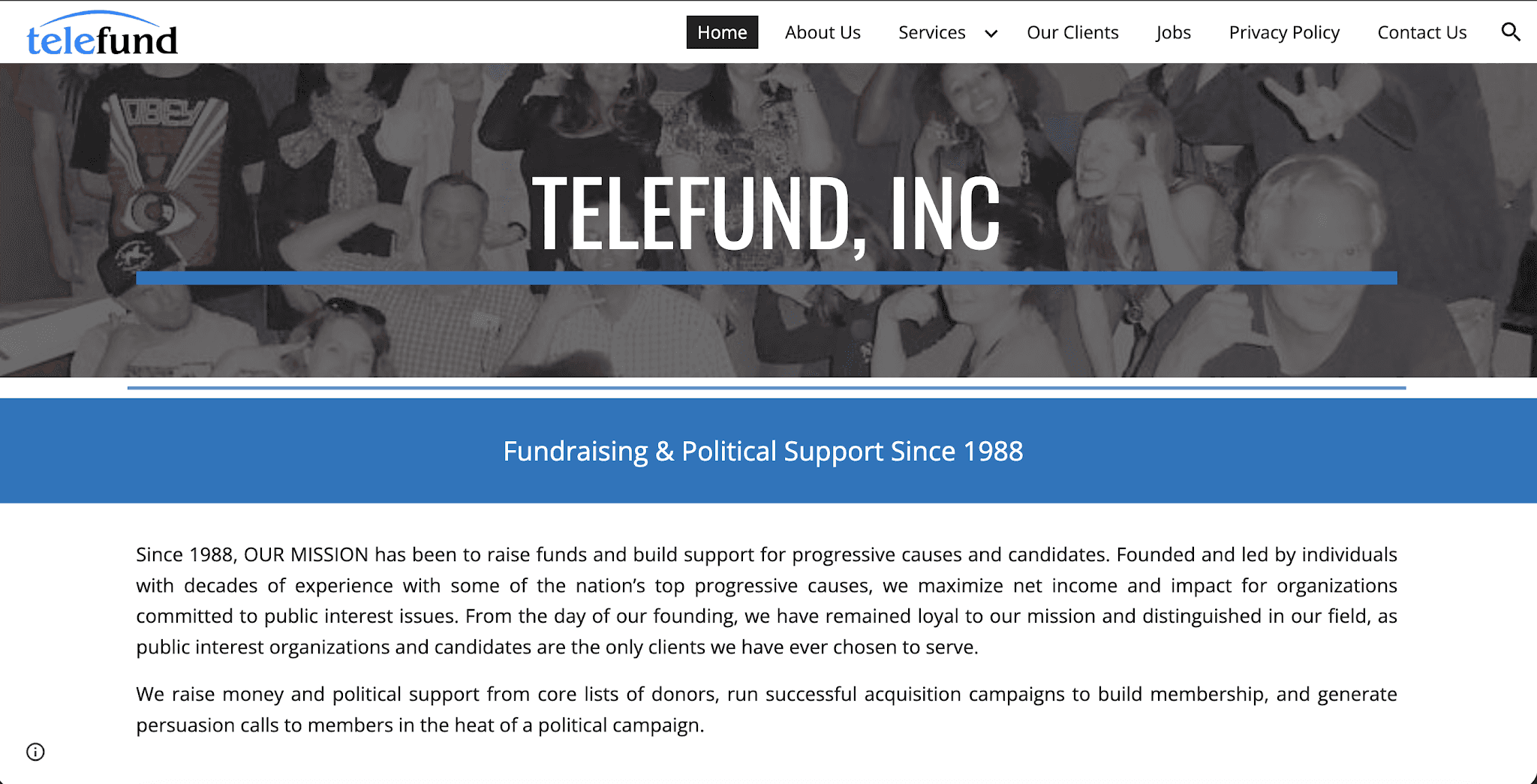
Telefund has a particularly recognizable footprint among progressive, environmental, advocacy, and public-interest organizations.
Its public client roster includes organizations such as the ACLU, Greenpeace, Human Rights Campaign, League of Conservation Voters, Planned Parenthood, Sierra Club, Oxfam, and others.
Telefund offers fundraising, information services, and fulfillment.
Its information services work includes reporting, list management, segmentation, phone appending, credit card data transfer, and suppression. Its fulfillment operation supports pledge mailings and follow-up.
Public Form 990 data reinforces that market position. Nonprofits reporting Telefund as a professional fundraising vendor include the Human Rights Campaign, ACLU, Planned Parenthood Federation of America, Humane Society, Sierra Club, Red Cross, Environmental Defense Fund, and others.
Pros
Clear specialization in progressive, advocacy, environmental, and public-interest organizations
Established live-agent fundraising model
Data-management and list services alongside calling
Pledge and mail-fulfillment capabilities
Public client roster makes organizational fit easier to evaluate
Glassdoor workforce rating of 2.7/5 from 103 reviews
Cons
Public service information emphasizes a traditional phone-and-mail operating model
Public pricing is not listed
Less visible integrated SMS/email/AI workflow than RNL or InfoCision
Organizations outside its typical mission profile may prefer a provider with a more neutral or broad client base
Who Should Choose Telefund?
Best for: Progressive nonprofits, advocacy organizations, environmental groups, and public-interest campaigns looking for experienced human telefundraisers.
Not ideal for: Organizations that want to own a reusable multichannel engagement system rather than outsource calling.
Pricing: Contact Telefund.
Bottom line: Telefund has a clear niche and a substantial history with nationally known advocacy organizations.
The Bigger Question: Do You Still Need a Telefundraising Company?
Here is the question I think matters most.
Do you need another team of people?
Or do you need more capacity?
Those are not always the same problem.
Traditional telefundraising companies solve capacity by supplying labor.
They recruit callers.
They train them.
They put them on the phones.
They manage the call center.
For some organizations, that is exactly the right answer.
But many fundraising campaigns are structured well enough that you may not need a professional human caller to handle every interaction.
That is where EverRaise can replace the outsourced telefundraising layer.
How EverRaise Can Replace a Telefundraising Company
EverRaise is not a call center.
It is an AI engagement platform that helps your own team build and run campaigns across voice, voicemail, SMS, email, transfers, and follow-up.
Instead of sending a list to a vendor and waiting for callers to work it, your team controls the campaign.
You define the audience.
You review the message.
You determine what the AI voice agent can say.
You choose the follow-up.
You decide when someone gets transferred or routed back to staff.
That difference matters.
When EverRaise Can Replace the Outsourced Calling Layer
EverRaise is strongest when the conversation has a clear job.
For example:
Thank first-time donors
Re-engage lapsed donors
Follow up on annual giving campaigns
Invite supporters to events
Remind people about pledges
Conduct surveys
Ask whether someone wants more information
Send a donation or registration link
Confirm interest
Route warm responses to staff
Follow up after an event
Reconnect alumni or members
A useful test is:
Is the purpose narrow?
Is the conversation reasonably predictable?
Are the stakes appropriate?
Is there a clear human handoff?
If the answer is yes, you may not need to pay a human call center to handle every call.
A Real EverRaise Example
In a recent university engagement campaign, EverRaise reached 868 people in less than five hours.
The campaign generated 163 live answers, 116 link clicks, a 22% live-answer rate, a 15% SMS click-through rate, and more than 20 staff hours saved.
The interesting part is not simply the call volume.
The campaign connected the voice outreach to SMS follow-up and reporting without requiring the university to recruit a temporary calling team.
That is the replacement opportunity.
For repeatable campaigns, software can replace much of the outsourced labor while keeping your internal team responsible for the relationships that need a person.
Which Option Should You Choose?
Choose MDS if you want a traditional nonprofit-only telephone fundraising provider with human callers.
Choose RNL if you are in higher education and want a managed phonathon or a digital engagement center model.
Choose SD&A if your organization is rooted in arts, culture, public media, membership, or subscriptions.
Choose InfoCision if you need a large-scale BPO partner for donor services and omnichannel contact center work.
Choose Telefund if you are a progressive or advocacy organization looking for an established human telefundraising operation.
Choose EverRaise if the real problem is that your team has more structured donor outreach to do than people available to carry it out.
The Bottom Line
For decades, the answer to “How do we call more donors?” was simple.
Hire more callers.
Build a phone room.
Or outsource the work.
Those are still valid options. But they are no longer the only options.
Before you hire a telefundraising company, separate the conversations that truly require another human from the work that simply requires more capacity.
For many thank-you, reactivation, reminder, survey, event, and follow-up campaigns, EverRaise can replace the outsourced calling layer and keep the campaign under your team’s control.
Then let your people spend their time where people matter most.
Continue Reading
You might also like
View all posts


