Pro Tips
Compare 8 donor management software options for nonprofits in 2026, including pricing, pros, cons, and what to look for when choosing a donor CRM.

Jesse Wisnewski
CEO & Founder
Published
Read Time
15 min read

Your nonprofit has a donor database. Maybe it has a few hundred names. Maybe it has a few hundred thousand.
You can probably look up who gave, when they gave, how much they contributed, and which programs they supported.
But here is the question I would ask:
What happens with that information?
Does a first-time donor receive thoughtful follow-up? Does someone notice when a recurring donor stops giving? Can your team identify supporters who attended an event but never heard from anyone afterward?
Keep these questions in mind when choosing donor management software.
The right platform should help you maintain accurate records, understand your supporters, organize fundraising, and make better decisions about what happens next.
But donor management systems are not interchangeable.
Some are designed for small nonprofits moving beyond spreadsheets. Others combine giving, events, and communications. A few are built for complex fundraising operations with dedicated advancement and database teams.
In this post, I’m going to cover:
Eight donor management software options worth comparing
Pricing, pros, cons, and the best fit for each
How I evaluated the platforms
What to ask during a software demonstration
Why donor management and donor engagement are different
How to turn donor information into more consistent follow-up
Let’s dig in.
Quick Comparison: 8 Donor Management Software Options
Software | Best for | Primary strength | Starting price |
|---|---|---|---|
Zeffy | Budget-conscious nonprofits | Free fundraising and donor records | Free |
Givebutter | Fundraising-first teams | Donations, campaigns, events, and CRM | Free core platform |
Little Green Light | Small nonprofits | Affordable donor database and reporting | $45/month |
Neon CRM | Growing nonprofits | Donors, memberships, events, and communications | $99/month |
Bloomerang CRM | Retention-focused teams | Donor insights and stewardship | $125/month annually |
DonorPerfect | Established fundraising teams | Gift management, reporting, and customization | $99/month |
Virtuous CRM+ | Teams investing in automation | Donor journeys and responsive fundraising | Custom quote |
Blackbaud Raiser’s Edge NXT | Complex fundraising operations | Fundraising CRM and donor intelligence | Custom quote |
Prices reflect publicly advertised entry points reviewed in October 2026. Actual costs can depend on database size, revenue, transaction fees, implementation, and additional products.
How I Compared the Platforms
I did not create an EverRaise rating or pretend we personally implemented all eight platforms.
Instead, I reviewed the products using six questions:
Who is the software built for? Small nonprofits, growing development teams, or large institutions?
What does it manage? Donors, gifts, campaigns, events, memberships, and other relationships?
How does it support fundraising? Segmentation, acknowledgments, recurring giving, major gifts, reporting, and stewardship?
Can the team actually use it? Does it require dedicated technical staff, or can development professionals manage it themselves?
What does it cost? Subscription, implementation, payment processing, add-ons, and ongoing administration?
What happens after the data is recorded? Can your team use donor information to guide the next useful action?
That final question shapes how I think about donor management.
A database should help you understand your supporters. But understanding a relationship and maintaining it are two different jobs.
What Is Donor Management Software?
Donor management software is a system nonprofits use to organize supporter information, track donations, record interactions, manage fundraising activity, and report on donor relationships. Many platforms also include online giving, recurring donations, email, events, segmentation, and automated workflows.
The term often overlaps with nonprofit CRM software.
The distinction is usually one of scope. Donor management focuses on fundraising relationships, while a nonprofit CRM may also manage volunteers, members, program participants, and other constituents.
With that in mind, here are eight platforms worth comparing.
1. Zeffy: Best for Nonprofits Seeking Free Donor Management Software
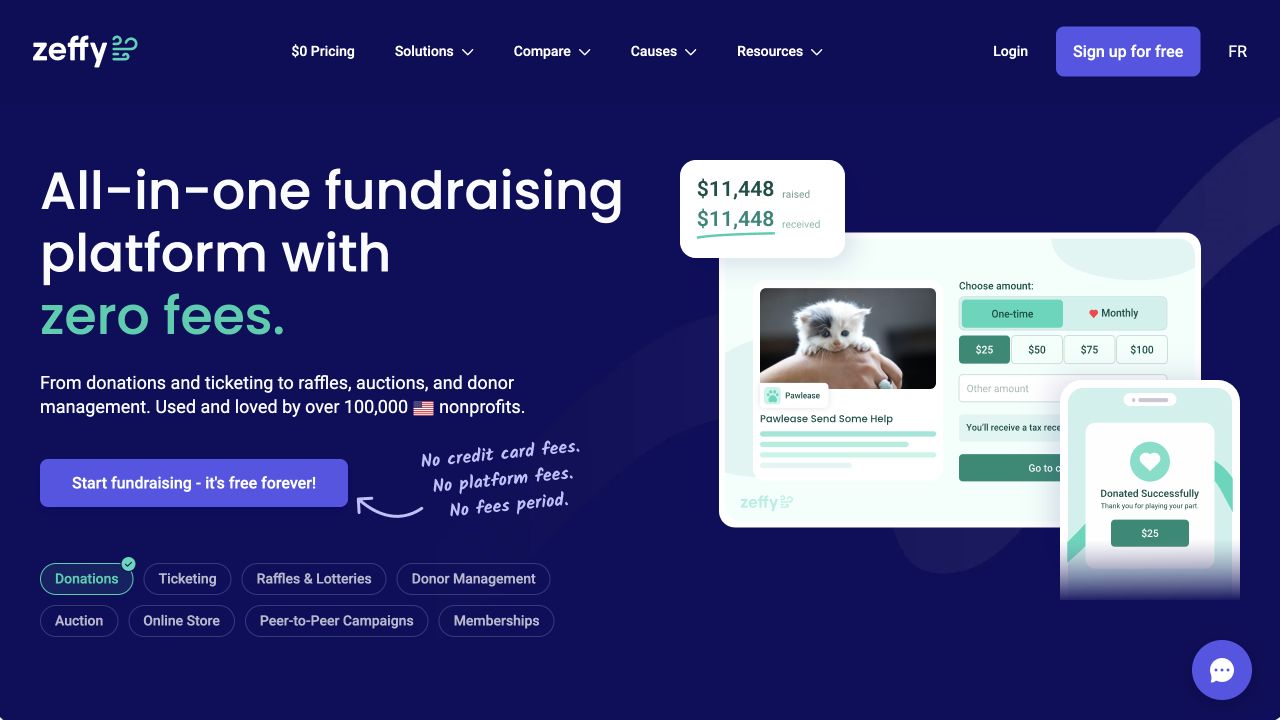
Zeffy combines fundraising and donor management without charging nonprofits subscription or standard transaction fees.
Its business model relies on optional contributions donors can make to Zeffy during checkout.
The software builds donor records from gifts, tickets, and registrations. Teams can import contacts, review giving history, segment supporters, send communications, and manage tasks.
That makes Zeffy attractive for organizations trying to organize fundraising without adding another monthly bill.
Pros
Free donor CRM with unlimited contacts
No standard platform or processing fees charged to nonprofits
Donation, event, and membership records connected
Contact imports, segmentation, and reporting
Email and task management
Cons
Closely connected to Zeffy’s fundraising ecosystem
Organizations should evaluate the optional-tip experience from the donor’s perspective
Complex major-gift and enterprise reporting workflows should be tested before migration
Specialized integrations may require additional review
Who Should Choose Zeffy?
Best for: Small nonprofits that want fundraising and basic donor management in one free platform.
Not ideal for: Organizations needing highly specialized donor database structures or complex advancement operations.
Pricing: Free. Zeffy funds its services through optional donor contributions.
Bottom line: Zeffy deserves consideration when your organization needs a reliable starting point without a software subscription.
2. Givebutter: Best for Fundraising-First Nonprofits

Givebutter approaches donor management from the fundraising side.
Its platform connects donation forms, campaigns, events, auctions, communications, and constituent records.
The core CRM is free, with unlimited contacts and users. Organizations that need advanced workflows, texting, task management, and expanded reporting can add Givebutter Plus.
Givebutter’s optional-tip model also matters when comparing costs. With tips enabled, its guarantee covers standard platform and processing fees for eligible transactions. When tips are disabled, a 3% platform fee and standard processing fees generally apply.
Pros
Free core fundraising CRM
Unlimited contacts and users
Integrated campaigns, events, and donations
Email marketing
Optional advanced automation
Relatively simple entry point for smaller teams
Cons
Advanced capabilities require Givebutter Plus
Costs change when optional tips are disabled
Some payment methods and transaction types have separate conditions
Complex fundraising database requirements deserve careful testing
Who Should Choose Givebutter?
Best for: Nonprofits running online campaigns, events, and fundraising activities that want donor records connected to those transactions.
Not ideal for: Organizations primarily shopping for a complex enterprise fundraising database.
Pricing: Core platform is free. Givebutter Plus starts at $29 per month on an annual plan for smaller contact tiers. See Givebutter’s pricing and fee details.
Bottom line: Givebutter is a strong option when your fundraising platform and donor database need to work closely together.
Related reading: Read EverRaise vs Givebutter: AI Engagement Beyond Forms for a closer look at how fundraising tools and donor outreach serve different needs, and when using both platforms may make sense for your nonprofit.
3. Little Green Light: Best for Small Nonprofits Moving Beyond Spreadsheets

Little Green Light focuses on accessible donor management.
Its platform helps nonprofits organize constituent records, gifts, pledges, communications, relationships, and reports without requiring a large software budget.
One distinction is its pricing model.
Little Green Light charges based on the number of constituent records, not the number of users. That can be helpful when multiple staff members or volunteers need access.
Pros
Straightforward, transparent pricing
Unlimited users
No required setup fees or long-term contract
Gift, pledge, and relationship tracking
Reporting and integration options
30-day free trial
Cons
Subscription costs increase as constituent records grow
Donation processing has separate transaction fees
Not primarily a multichannel engagement platform
Some sophisticated fundraising workflows may require additional tools
Who Should Choose Little Green Light?
Best for: Small nonprofits ready to replace spreadsheets with a dependable donor database.
Not ideal for: Large organizations with highly complex fundraising operations.
Pricing: $45 per month for up to 2,500 constituent records, $60 for up to 5,000, and $75 for up to 10,000. See Little Green Light pricing.
Bottom line: Little Green Light is worth evaluating when simplicity, cost, and dependable recordkeeping come first.
4. Neon CRM: Best for Growing Nonprofits With Multiple Programs

Neon CRM combines donor management with broader nonprofit operations.
It supports giving, campaigns, recurring donations, grants, reporting, communications, and automated workflows. Organizations can also add membership, event, and volunteer capabilities.
Neon’s pricing is based on organizational revenue rather than contact count.
That approach may appeal to organizations expecting their supporter database to grow, although the subscription can change as the organization grows.
Pros
Donor and constituent management
Fundraising campaigns and recurring giving
Automated stewardship workflows
Email and text communication
Reporting and dashboards
Optional membership, event, and volunteer modules
Cons
Revenue-based pricing may increase over time
Additional modules raise the total cost
Broader features may require more setup and training
Teams should test whether specialized workflows fit their needs
Who Should Choose Neon CRM?
Best for: Growing nonprofits managing donors alongside programs, events, memberships, and other constituent relationships.
Not ideal for: Small teams that need only basic gift tracking.
Pricing: Starts at $99 per month. Additional modules cost extra. See Neon CRM pricing.
Bottom line: Neon makes sense when your nonprofit needs a broader system for relationships and operations, not simply a donation database.
5. Bloomerang CRM: Best for Donor Retention and Stewardship

Bloomerang CRM has positioned itself around helping nonprofits understand and retain donors.
The platform combines constituent records with giving history, segmentation, reporting, stewardship, automated supporter journeys, and donor insights.
It also includes tools for major gifts, task management, and communication.
I think that makes Bloomerang particularly relevant for nonprofits trying to become more intentional about what happens between donations.
Pros
Strong focus on donor retention and stewardship
Supporter history and relationship insights
Segmentation and reporting
Built-in email and automated journeys
Task and major-gift management
Unlimited CRM users
Cons
Higher starting subscription than lightweight databases
Additional fundraising and volunteer products can increase cost
Organizations should confirm which features are included in their package
Teams still need to design and manage their stewardship processes
Who Should Choose Bloomerang?
Best for: Development teams investing in better donor stewardship, reporting, and relationship management.
Not ideal for: Organizations that only need a low-cost donor database.
Pricing: Starts at $125 per month, billed annually. See Bloomerang’s pricing.
Bottom line: Bloomerang belongs on the shortlist when the organization’s priority is understanding donors and supporting more intentional follow-up.
6. DonorPerfect: Best for Established Fundraising Teams

DonorPerfect is an established nonprofit fundraising CRM.
Its platform supports donor and gift management, donation forms, reporting, email marketing, campaigns, and automated processes.
Organizations can select different fundraising suites depending on their needs.
That flexibility can help development teams that have outgrown a simple database but don’t necessarily need a large enterprise platform.
Pros
Established fundraising CRM
Donor and gift management
Campaign tracking and reporting
Customizable dashboards
Email marketing
Integrated donation forms
Automation and stewardship capabilities
Cons
Pricing depends on the selected suite
Advanced capabilities vary by package
Configuration and reporting may require training
Buyers should clarify onboarding, migration, and integration costs
Who Should Choose DonorPerfect?
Best for: Established development teams that need more flexible fundraising records, reporting, and campaign management.
Not ideal for: Very small nonprofits looking only for simple donor tracking.
Pricing: Fundraising suites start at $99 per month. See DonorPerfect’s pricing guide.
Bottom line: DonorPerfect is a reasonable candidate when your fundraising operation needs more structure and flexibility than an entry-level CRM provides.
7. Virtuous CRM+: Best for Responsive Fundraising and Automation
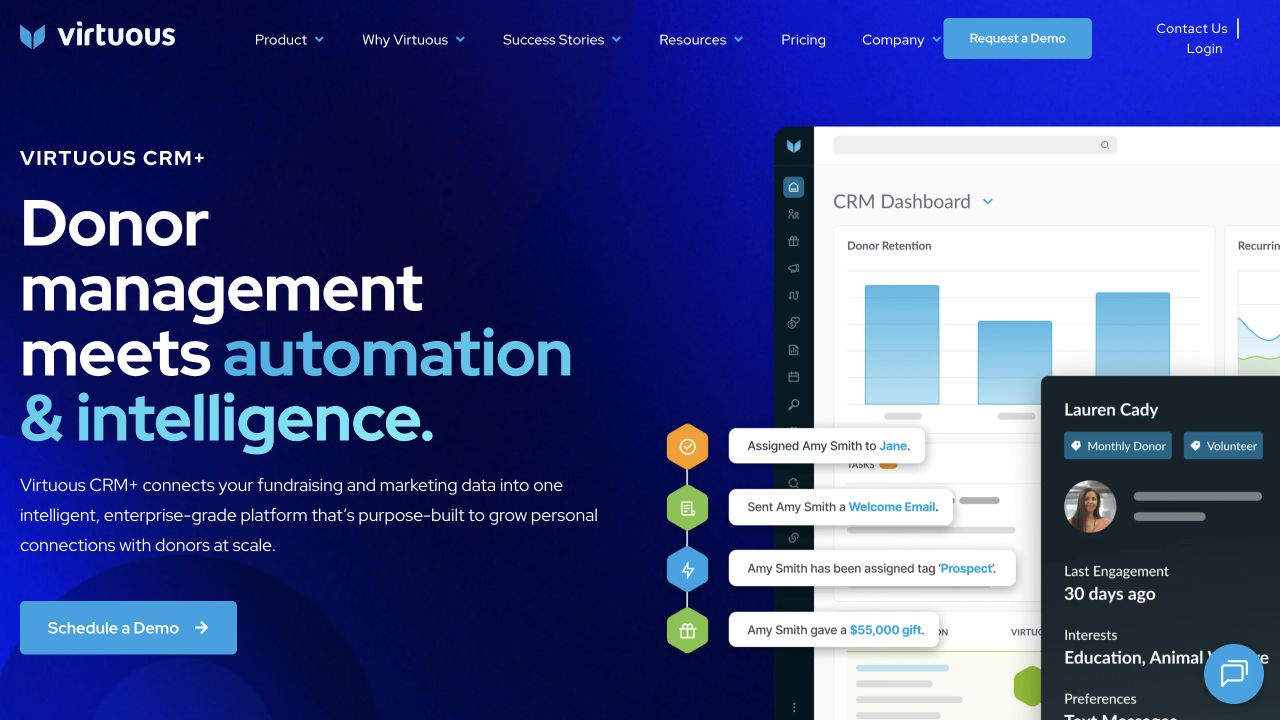
Virtuous CRM+ connects donor management with marketing automation and fundraising workflows.
Its platform includes donor and pipeline management, communications, events, reporting, journey automation, and integrations.
Virtuous emphasizes using donor information to guide more relevant fundraising and stewardship.
That distinction matters for teams that want to build connected donor experiences rather than simply manage transactions.
Pros
Donor and pipeline management
Marketing automation
Donor journeys and workflows
Segmentation and reporting
Communication tools
Unlimited CRM users
Additional fundraising products available
Cons
Public subscription pricing is not listed
Implementation may require more planning
Additional products can affect total costs
Some smaller nonprofits may not need its broader automation capabilities
Who Should Choose Virtuous?
Best for: Growing development teams ready to invest in connected donor journeys, automation, and responsive fundraising.
Not ideal for: Small nonprofits needing an inexpensive database with little configuration.
Pricing: Custom quote.
Bottom line: Virtuous is worth considering when your team wants donor management and communication workflows to operate more closely together.
8. Blackbaud Raiser’s Edge NXT: Best for Complex Fundraising Operations

Blackbaud Raiser’s Edge NXT is designed for organizations with substantial fundraising needs.
Its platform supports donor and gift records, campaign management, fundraising intelligence, analytics, and relationship workflows.
For a national nonprofit, large ministry, hospital foundation, or university advancement operation, complexity can be unavoidable.
You may have multiple fundraising departments, gift types, donor relationships, approvals, reporting structures, and integration requirements.
That creates a different purchasing decision from the one faced by a three-person development office.
Pros
Built for complex nonprofit fundraising
Detailed constituent and gift management
Major-gift and campaign capabilities
Reporting and analytics
Donor intelligence
Broad nonprofit software ecosystem
Integration options
Cons
Public subscription pricing is not listed
Implementation may require significant resources
More administration than many small nonprofits need
Training, integrations, and additional modules can affect total ownership costs
Who Should Choose Raiser’s Edge NXT?
Best for: Larger nonprofits, universities, foundations, and complex fundraising organizations.
Not ideal for: Small nonprofits seeking a simple and inexpensive database.
Pricing: Custom quote.
Bottom line: Raiser’s Edge NXT deserves consideration when your fundraising needs justify a more extensive CRM investment.
Which Donor Management Software Is Right for Your Nonprofit?
If I were narrowing the options, I would start with the job and the organization’s stage.
For a small nonprofit with limited resources, I would compare Zeffy, Givebutter, and Little Green Light first.
For a growing development office that wants broader fundraising, stewardship, and communication capabilities, I would evaluate Neon CRM, Bloomerang, DonorPerfect, and Virtuous.
For a large institution with complex advancement operations, Blackbaud Raiser’s Edge NXT deserves a closer look.
That does not mean one product is universally better than another.
It means the purchasing decision should match the organization.
How to Evaluate Donor Management Software Before You Buy
Here is an exercise I would encourage every nonprofit to complete.
Before you sit through another product demonstration, write down five real donor situations.
Then ask each vendor to demonstrate exactly how its software handles them.
1. A new donor makes a $100 gift
Can the system create or update the record, acknowledge the gift, identify the donor as new, and support the next step?
2. A recurring donor’s payment fails
How does your team learn about the failure? Is there a recovery workflow? Who owns it?
3. Someone attends your fundraising event
Can your team connect attendance to the donor record, identify relevant interests, and determine what follow-up makes sense?
4. A donor requests a conversation
Can you assign the request to the right fundraiser? Does that person have the history needed to follow up well?
5. A donor stops giving
Can you identify the donor, review their history, segment them, and plan an appropriate reactivation effort?
I would also ask the vendor to show the complete process live.
Not just the dashboard.
Not just the feature list.
Ask them to show you how the work gets done.
For each scenario, document whether the process works natively, requires another product, or needs manual intervention.
Then request a three-year cost estimate covering implementation, training, migration, payment processing, add-ons, and likely database growth.
Finally, ask how your organization would export its complete data if you chose to leave.
That one exercise will tell you more than most comparison charts.
Donor Management Is Not Donor Engagement
This is the distinction I think nonprofits often overlook.
A donor management system helps you understand what happened.
A donor engagement system helps your team act on what it knows.
Consider a donor who gave last November.
Your CRM may know the amount, date, campaign, previous gifts, and communication history.
That is valuable.
But it doesn’t guarantee someone will thank the donor, share an impact update, invite them to reconnect, or notice if they stop responding.
Good donor management platforms increasingly include email, task management, and workflow automation.
Those features can help.
But a feature only creates value when the organization uses it to support the relationship.
A database can tell you that someone attended an event.
The important question is what happens afterward.
Our article on donor engagement goes deeper into how nonprofits can turn those moments into consistent follow-up.
Why This Matters for Donor Retention
The Fundraising Effectiveness Project’s 2025 findings highlight a difficult trend.
Total charitable dollars raised grew an estimated 5.0% in 2025.
But the number of donors declined 3.6%.
Overall donor retention was 43.3%.
Those figures matter because growing fundraising revenue does not necessarily mean an organization is maintaining a healthy donor base.
Better donor management helps you see what is happening.
Better stewardship and engagement help your team decide what to do about it.
That does not mean installing new software guarantees higher retention. Donors stop giving for many reasons.
But consistent follow-up is one part of the donor experience your organization can intentionally improve.
What Good Donor Follow-Up Looks Like
DonorsChoose provides an interesting example.
After a classroom project is funded and implemented, teachers complete a thank-you package for supporters.
According to the organization’s thank-you package guidelines, that process includes an impact letter, photographs, and qualifying student thank-you notes.
The point is not that every nonprofit needs handwritten letters from students.
The point is that the gift creates a defined next step.
The organization has a process for showing supporters what happened because they gave.
That is what good donor stewardship looks like when it becomes operational.
Where EverRaise Fits
This is where EverRaise comes in.
EverRaise is not a donor CRM.
It is an AI engagement assistant for relationship-driven organizations.
The distinction matters because many nonprofits already have a system that stores donor information.
What they often lack is enough staff capacity to act on that information consistently.
Your CRM may identify:
First-time donors who need follow-up
Lapsed supporters worth reconnecting with
Event attendees who should receive an invitation
Recurring donors who need attention
People who expressed interest in a program
Donors who requested more information
EverRaise helps teams build and execute approved outreach campaigns through AI voice, SMS, email, surveys, contact validation, and follow-up workflows.
Your organization remains responsible for the strategy, appropriate permissions, message approval, compliance practices, and donor relationships.
The goal is to give your staff more capacity, not remove them from the relationship.
A Real EverRaise Example
In one university engagement campaign, EverRaise reached 868 contacts in less than five hours.
The campaign produced:
163 live answers
116 link clicks
More than 20 estimated staff hours saved
We shared those results in our September EverRaise product update.
Those are results from one campaign, not a promise of what every organization should expect.
The important part is what the organization could learn and act on.
Who answered? Who clicked? Who expressed interest? Which records needed attention? Where should a person follow up?
That is the difference between recording interactions and using interactions to inform the relationship.
Your donor management system should remain the source of truth. An engagement assistant can help your team turn that information into action.
Frequently Asked Questions About Donor Management Software
What is the best donor management software for nonprofits?
The best donor management software depends on your organization’s size, budget, fundraising needs, and staff capacity. Zeffy, Givebutter, and Little Green Light are useful starting points for smaller nonprofits. Neon CRM, Bloomerang, DonorPerfect, and Virtuous offer broader fundraising capabilities. Raiser’s Edge NXT serves more complex operations.
Is there free donor management software?
Yes. Zeffy provides free fundraising and donor management software supported by optional contributions from donors. Givebutter offers a free core donor CRM and fundraising platform with optional upgrades. Evaluate both for payment terms, integrations, reporting, and long-term fit.
What is the difference between donor management software and a nonprofit CRM?
The terms frequently overlap. Donor management software focuses on gifts, supporters, and fundraising relationships. Nonprofit CRM software may also manage members, volunteers, program participants, events, and other constituent activity.
What features should donor management software have?
Look for accurate constituent records, gift tracking, acknowledgments, segmentation, reporting, permissions, and reliable data export. Depending on your needs, you may also require recurring giving, email, major-gift management, events, automation, and integrations.
Can donor management software improve donor retention?
Donor management software can support retention by helping teams identify donors who need attention, maintain accurate information, coordinate stewardship, and track follow-up. It cannot guarantee another gift. Retention also depends on the donor experience, mission, communication, and other factors.
The Bottom Line
Choosing donor management software is an important decision.
The platform you select becomes part of how your nonprofit remembers gifts, relationships, conversations, and opportunities.
Choose something your team can actually use.
Make sure it fits your fundraising operations, budget, and future needs.
But do not confuse buying the database with building the relationship.
Good donor management helps your team understand supporters.
Good engagement helps your team respond to what it learns.
Because the goal is not simply better records.
It is stronger relationships.
Engagement drives retention. Retention drives revenue.
Continue Reading
You might also like
View all posts

Pro Tips
Learn donor communication best practices for new, active, and lapsing donors, plus a practical system for consistent follow-up and stronger relationships.

Pro Tips
Compare five donor engagement software platforms for nonprofits, including pricing, strengths, limitations, and how to choose the right solution.
